
I still get asked a lot about my joke writing process, and I’d like to discuss an aspect of it today. Even better, I’m going to deconstruct my most recent joke and show you how I do it.
Disclaimer: this is not to say I have a great system or that my jokes are excellent. That’s for you to say. All I’m doing is demonstrating an important part of my own creative process.
My process is zero discipline. I designed it that way because I have zero discipline.
Well, actually that’s not quite the whole truth. A more accurate statement might be that I have too much going on.
I’m writing another book. don’t worry, it’s got nothing to do with stand up comedy so I won’t bore you with it too much here. but I’ve contracted an illustrator for it and when I met with him again last week he told me something that sums it up.
He knows about my demanding day job and that I’m currently applying for a promotion to a role that promotes to be even more demanding. He also knows I write books, run this website, do the stand-up comedy thing regularly as well as assist with all the demands from home and helping the stakeholders in my life with the stuff they’re trying to do. He said I’m exhausting to watch, that I’m spread thin and always busy. Yep, that’s a pretty accurate take. My ADHD extrapolates out to a busy and exhausting life.

So when I look at the comedy writing advice that’s prevalent – the whole idea that you should dedicate several hours a day and grind at it, no matter how uninspired you feel and no matter how little progress you make with the material itself- I have to remind myself that this doctrine is pitched at professional comedians who regularly joke that they work for less than an hour a day.
If you’re blessed with a career that asks less than 7 hours a week from you, have at it. As for the rest of us, ain’t nobody got time for that.
I’ll also submit that I don’t believe it’s particularly productive, for a range of reasons I’ve discussed elsewhere. It’s a process that doesn’t reward you sufficiently for the time and effort you put in. That might be why nobody actually does it.
My system is lazy. It doesn’t require hours of grinding. It does need patience and attention, though.
Basically, I collect ideas.
Literally. Anything interesting, silly, amusing, weird, whatever. This could be a weird thought, a news article, an advertisment, something someone says, something I see out in the world, anything. Usually I’ll put it in the notebook so I don’t forget.
It doesn’t have to be a joke either. Anything weird. Something comedians will often say is “Is this anything?” Jerry Seinfeld made that the title of a book (a book I bought and don’t recommend, btw).
Contrary to popular opinion, comedians don’t just incept jokes fully formed. Comics pick up ideas, evaluate them for their potential, and try to develop them into jokes.
Sometimes comedians try to cheat by choosing a premise that’s already pretty amusing so they don’t have to develop or polish it too much. I’ve mentioned previously that this is bullshit practice which almost never yields a result others will find original or funny. You’re better off spotting potential in an idea and working with it.
Sometimes a fully formed funny will manifest out of nowhere for you, like a visit from divine entity. And if that happens, you have a win. The rest of the time you’ll have to take raw material that’s not quite a joke yet and polish it until it is.
Which brings us to the “Is this anything?” question that comedians ask when evaluating an idea for potential.
When I have an interesting idea or see something amusing, I ask myself “Is this anything?” and put it in my ideas bucket. I don’t care if it’s not quite a joke yet. If I found a fully formed and developed joke just sitting there in the wild, I might suspect it’s a trap. And I sure won’t feel like I wrote a joke that was already written for me.
So, when I find myself asking “Is this anything?” of course it’s not an actual joke yet. Only a moron expects to find fully developed jokes sitting around unclaimed. It’s ingredients for a joke. I’ll have to cook the joke myself later.
I don’t work too hard at developing a joke. If it’s final form doesn’t immediately suggest itself to me, I’m happy to put it in the ideas bucket. One way to develop an idea into a joke will be to extrapolate it out, see if it fits with any of the joke structures, If you’ve read Scott Dikker’s book, you’ll run the idea through his 7 “funny filters” – that sort of thing.
But another way, my favourite way, to develop an idea is to mash it with another idea. That’s why I’m so big on collecting interesting ideas and carrying them around with me.
Like I said, my way requires patience and diligence. I need to be ok with the idea that my ideas don’t always turn straight into jokes immediately, and I need to be prepared to fill my mental real estate with them so I can recognise an opportunity to mix them with other ideas that arise.
Fortunately that’s not as hard as it sounds, thanks to the Zeigarnik Effect.
Let’s look at an example, one of my most recent. I don’t need you to believe it’s the greatest joke ever told, just that it’s the best example I can use here.
A few weeks ago Lotto contacted me with an email that said “Congratulations! You’re a Winner!”
I “won” $8 from a ticket that cost $22.
I could go broke “winning” like that.
I wondered what lying idiot would call that a win with a straight face.
Then I saw Trump tell us he “won” the war he started with Iran while giving them $300 billion.
I’m starting to get it now.
One point before diving into this: I’ve copied and pasted that straight from my Facebook page. I’ll be writing a future post about it but for now it’s important to acknowledge that different channels and platforms don’t all work the same and this test was optimised for print. Doing a stand-up performance, I opt for slightly different wording.
OK, so there’s two parts of this joke. The first bit is basic, something that actually happened. That is “winning the Lotto” with a prize that’s worth less than the cost of the ticket. It’s a simple idea, and relatable. I think we all have experienced this phenomenon and had the same thought that it’s not really winning even though they say so.
I thought about it a bit. I wrote down some stuff like “I could go broke from winning like this” and a few phrases that played with the word “gaslighting.” It was simple and salient and made a point but all I could get to was ‘amusing’
I’ll explain this point. There’s a couple of local comics who’ve described me as a mentor over the years and to them I explain that laughter, real out-loud laughter, is an involuntary response. It’s what we seek but it’s hard to achieve.
You can’t get an involuntary response just by saying something something people agree with. I can say things that make people clap and cheer and call out “yeah!” This is called “Clapter” and it’s better than nothing, I guess, but it’s an easily achieved Bronze Medal when we’re really going for Gold.
You also can’t get to an involuntary physical response by being interesting or amusing. Interesting or amusing works the same as Clapter. It’ll get you through a set and allow you to feel good about it, but interest and amusement are the same as approval. It’s an easy to get Bronze, but if that’s what you settle for you’ll never know that amazing feeling you get from winning the Gold.
Stand up comedy can be easy. If you’ve got a ten minute set to get through and want to avert disaster, you can say things that people like/approve of/agree with/find amusing/find interesting and you’ll survive respectfully. You will leave the stage with your head held high while people applaud. It’s actually not that hard to avoid disaster and have people like you. Enjoy your Bronze. You’re a winner.
But here’s the bit where stand-up is hard: winning gold. Actually evoking the visceral, involuntary physical response of out-loud laughter. There’s a spectrum of funny. Amusing is easy. Laughter is hard. As I tell my protégées, their challenge always is to move the needle from Amusing to Laughter-Inducing. While delivery and performance count for a lot, the missing ingredient to get from amusing to funny is in the writing. It’s baked into the structure of the joke itself.
It’s perfectly acceptable to bring amusing material. Many comics account for themselves well with amusing material, sometimes for years. They’ll get applause and feel OK about it. The room likes you. Until someone else actually makes people laugh out loud. When another comic can do that, the room forgets all about you. It’s not the end of the earth, but sooner or later most comics with amusing material end up asking what they can do to move that needle.
I’m guessing my advice differs from most people’s. I think the answer is to punch up the material. Most people think it’s an experience thing, and that a ton of additional “amusing” gigs will just level them up eventually. Some think it’s a presentation thing, that it’s just a matter of being more performative or polished in your delivery.
Of course these things are all good, but none of them substitute for missing essential ingredients. I think you’ll level up much quicker if you take a good look at what “Laugh Out Loud Funny” has that “Amusing” doesn’t. I’ll suggest that those things include (but might not be limited to) the elements of surprise, tension, and juxtaposition.
Your entertaining yarn might be fun and amusing, might hold everyone’s interest for the duration, and will probably get enthusiastic applause at the end. But if there’s no surprise, tension, or juxtaposition, I’m not optimistic about your chances of getting out-loud laughter.
Anyway, back to my joke.
A few weeks ago at Fresno I introduced the first half of that joke, saying I could go broke from “winning” that cost me $12 each time. I told the audience at the time that this isn’t really a joke yet, it’s an idea but I just had to share it. My onstage persona is characterised by exasperation, and my audience indulges me when I tell them that it’s not entirely a joke yet but I just have to get it off my chest. This exercise is similar to what we do in open mics – bring our ideas and try to work them out on stage.
The result was exactly as I’d predicted. I was making the audience laugh so they were more than happy for me to spend 45-60 seconds discussing something that is merely amusing but comes with the promise it’ll become a joke before moving back to other laughter-inducing jokes. And yes, the “congratulations, you’re a winner!” part I brought to the set was amusing and didn’t evoke much more than agreement and chuckles.
I also tried to close the set with a callback to it, saying something along the lines of “Because I’m a Winner!” which seemed like a good idea at home with a pen in my hand but didn’t really earn its keep. In the Callbacks of my book I explain that callbacks are awesome and magically powerful, but make sure you’re calling back to a joke that worked. Reminding people of something that didn’t work so well is a tactical error – a tactical error I made on this occasion.
But I managed to confirm what I pretty much already knew – that “Congratulations!” is a worthy idea but right now it’s only amusing which means I can’t count it as an actual joke yet. It needs the special sauce, the ingredient that moves the needle from Amusment to Laughter.
I’m pretty sure the secret ingredient in this case is, like most cases, juxtaposing another idea. I don’t think that saying it differently or trying to find new punchlines with the same raw data is going to get us there.
Did someone say another idea? Fast-forward a couple of weeks and the news cycle has offered gifts, as it usually does.
Donald Trump has declared he won his war on Iran for the 50th time this year. Social media is filled with wry observations about how many times you can win the same way, that he’s won this war more often than anyone has ever won a war. Turns out that “winning” means Trump has to pay $300 billion dollars to Iran.
Commentators are saying not only is this not a win, but Trump’s expensive exercise has taught Iran and everyone else that Iran has a lot more power over the world’s economy than they or anyone thought. Epic fail.
And I’ve got another half-formed idea. The idea that Trump is, contrary to his bullshit branding, terrible with money and terrible at managing business. He bankrupted a casino! Before Trump, nobody knew it was possible to bankrupt a casino. We all thought they just kept printing money forever, no matter what.
But Trump proved that even casinos aren’t immune to his business killing touch that has bankrupted several other businesses. And I’m playing with the idea that only the guy who managed to run a casino broke could fuck up the US economy like he has. I’m playing with the idea that his $300 billion payout to the “losers” of the war (and the losers of wars usually do the paying, so there’s your first clue) is the only thing that’s helped me understand how someone could possibly be fucked enough to bankrupt a casino.
It’s a worthy idea. It’s an amusing idea. I don’t think it’s funny yet, not a joke that can stand on it’s own. It needs something more before it can move the needle and ignite like a good laugh-causing joke does. What does it need? I think it needs to be reframed or repurposed. I think if we mix it with another joke we can get a chemical reaction happening.
And this brings us to “Congratulations! You’re a Winner!” Smash it with “Winning costs Trump $300B” and now it all makes sense. It works on stage and as I mentioned, it even works in print on a Facebook newsfeed. Suddenly it’s topical and has much more to say. And yes, the needle is moved.
As I mentioned, my approach to jokes is lazy but it also requires patience and attention. I want to bring new ideas to the stage as soon as possible, but I now have the discipline to put it to one side and remind myself it will probably make more sense later when I find the other piece of the puzzle.
And then I have to keep it and all the other ideas in a part of my brain where I can recall it later when the other piece of the puzzle does present itself. Not gonna lie, some of these ideas have been sitting in my too-hard basket for five years or more.
I’m fine with that. Some ideas might never graduate or find their perfect match, and that’s OK. I like having a lot of stock in my ideas pantry. This system hasn’t hindered my productivity – I think I’m as prolific as any comedian I know, and I suspect I’m working less hard than they are.
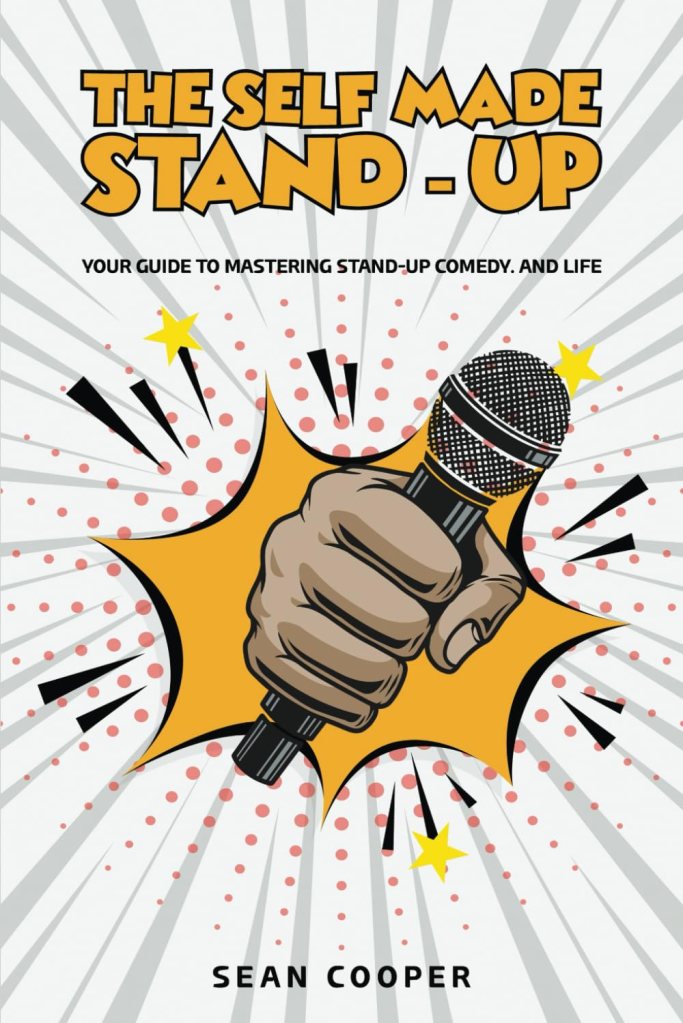
The Self Made Stand Up is available as a paperback or e-book from Amazon, Barnes and Noble and lots of other places.
More than a how-to book, The Self-Made Stand-Up is an essential resource for developing yourself as an effective comedian. If you’re a comedian, or looking to become one, The Self-Made Stand-Up is the emotional support animal you need.
You might want to consider joining my mailing list (I promise I won’t spam you)
 Sean Cooper, Comedian