Let’s talk movies for a moment. Who’s seen Eternal Sunshine of the Spotless Mind? If you haven’t, I’m prescribing it to you as essential viewing. It’s an incredibly moving and meaningful film that gets better every time you see it.
This won’t spoil the movie for you, but I’ll describe the beginning. We see a character study of one of the protagonists as they wake on a sofa bed and start their day by ditching work and impulsively catching a train, walking and journaling on a frozen beach, visiting a cafe, and then meeting a romantic interest on the train trip home.
The meeting is flirty and we then see it develop into a relationship, a deep relationship. We see this relationship evolve,and then dissolve. It’s an emotional gut punch.
Then, and only then at the 18 minute mark, do we see the opening credits of the movie. That’s right, that was just the introduction.
It’s a ballsy move, one that’s not favoured by a Hollywood industry that likes to see the title and their names on the screen as early as possible. In the Hollywood model, the title sequence gives you the context for the beginning of the film – not the other way around. Rarely does a movie get your emotional investment before introducing it. It’s not done a lot, although the Pixar film Up might be another example. It’s hard to pull off successfully and goes against most conventional wisdom.
Which brings us to the fine art of stand-up comedy.
The conventional wisdom in the world of stand-up is to get the first laugh as soon as possible. It’s almost a law. The first thing a comic says is a critical deciding factor in how the rest of the set goes, so comedians are urged to open with something fast and funny, something that will evoke the first laugh within 15-20 seconds. Usually the instruction is even more specific than that. The comic will be typically advised to open with a self-deprecating joke, preferably based around their appearance.
It’s important to note there is sound reasoning behind this advice. Getting an early laugh is important to both the comic and the audience. People in comedy audiences make instinctive unconscious judgments as quickly as they do in the rest of the world, and how positive or negative those judgments are will colour how the whole performance is received.
Eliciting a positive reaction from the audience creates trust. It establishes the comedian’s authority and lets the audience know they’re in safe hands for the rest of the voyage, that they will have a good time.
For the comedian, getting that early laugh helps with the confidence level. It dispels stress and gives the comedian permission to continue.
Why do the self-deprecating opener? Because Superiority Theory is maybe the most direct and primal of comedy’s three main drivers. Targeting oneself at oneself signals humility and negates assumptions of arrogance that are sometimes an unfortunate by-product of Superiority Theory. Referring to something visible to everyone in the room does two jobs. It acknowledges and addresses a shared experience, making sure it doesn’t distract for the rest of the evening, and it cuts down the exposition required for a setup – taking us straight to the punchline and getting that first laugh quickly.
As I said, there are logical reasons why a quick snappy one-liner directed at one’s own physical appearance has been the default opener used by most comedians for literally decades. It makes so much sense that only a complete fool might dispute it.
Hi, I’m Sean.
For the record, I regularly deploy this tactic. I know how much practical sense it makes, and I usually try to optimize my openings to set myself up for success when I perform. I’m not going to tell you that it doesn’t work or that people haven’t been reliably laughing at this joke (and it’s variants) for a very long time now. I start my set early, getting my first word into the mic as soon as possible, go straight into material instead of fucking around with greetings and waffle, open with a joke that will get to a punchline quickly.
Most of the time, all that housekeeping shit of acknowledging the audience, introducing yourself and introductory waffle should be left to the MC. Start with a joke, a funny one that will establish your credibility and authority as a funny person. If there’s something visible about your appearance or the way you dress, acknowledge it immediately to prevent it from becoming an intrusive thought later. If you can do that in a way that shows everyone how humble and hilarious you are, bonus points.
Set the tone and make sure you draw first blood. These are the rules of engagement.
But let me offer an alternate point of view for your consideration.
I’m not decrying the dogma, but I do believe that taking chances and testing our assumptions are seriously lacking in comedy for the last few years now, resulting in a less vibrant comedy scene than before. Lots of comics will tell you that cancel culture or woke political correctness are the culprits, but that’s invariably because they are shitty, unfunny and don’t get it. Thank fuck for those people that their podcasts and grifts generate enough revenue to compensate for their shittiness. But I digress.
The first reason to question the tactic is it’s own success.The “I know I look like” joke is so singularly optimised that everyone does it. No comedian should be doing the same joke as everyone else, but everyone seems ok with this particular instance. It’s not only the same joke that many others are currently doing; it’s the same joke that other comics were using decades ago.
How is this OK? I can only speculate that the tiny bit of tweaking needed to personalize it has somehow tricked us out of recognizing the most common joke in the world. Weird….
The second aspect to challenge is that it’s a very particular structure and style of joke, one that doesn’t necessarily suit everyone. I don’t do a lot of self-deprecating humour so this sort of thing is a bit off-brand for me. I haven’t traditionally traded in a ton of one-liners or Superiority Theory.
I’ll concede that I’m using a lot more of both in the last two years, but there’s still the concern that the opener won’t resemble the rest of my set or my act. In that case the quick opener could be a false promise, which is exactly the opposite of what it’s designed to do.
My third point is the one I’ve been personally exploring. As I mentioned, I’m generally trying to optimize my opening and establish authority as soon as I’m in range of the mic, but lately I’ve challenged that format to see if delaying that first laugh can be effective.
You might be surprised to know it’s gone better than expected. In April I did a couple of gigs where I opened with a bit about what a weird month April is, and I don’t even try to get a laugh until about 45 seconds in. It’s worked with longer sets, but it also did better than expected in a short one.
I suspect this is because of another one of those laughter drivers, Relief Theory. This is the idea that laughter comes from creating and releasing tension. By design, it can’t possibly be deployed as quickly as a rapid Superiority burst. You need to build. The more tension you build, the better the result.
The bit I’ve been opening with lately plants a lot of seeds, which takes time before I get to reap the rewards. The first of those returns is nearly a minute in, but the harvest continues for the rest of the set. I was trying to design the set as an engine that takes a moment to build momentum but gradually becomes an unstoppable juggernaut. I reasoned that really a strong close could be more memorable than a cheaply achieved effective opener.
It’s the same trick as Eternal Sunshine of the Spotless Mind; get an emotional investment first and the payoff will feel deeper and more significant. I’m not going to lie – it’s a risky game, and there are many reasons to take the conventional route. I’m definitely not going to urge everyone to do it. My own attention span is less than I’d like it to be, and I can’t argue that anyone else will grant you a full minute before you prove yourself.
What I will tell you, though, is that you should be trying stuff.
Look, if you’re hosting the Oscars or polishing your tight five for a late-night TV performance, you should absolutely be using time-tested and proven techniques. But for me and most comics I know, most individual gigs aren’t that significant. You can afford to experiment a little.
Especially if you’re trying to avoid repeating the same joke that’s been used by almost everyone else for nearly half a century, because safe plagiarism is only going to ensure all your gigs are insignificant. You might not feel like you have a right to gamble recklessly with your audience’s patience and attention span, and I’d be inclined to agree with you – to an extent.
But you also shouldn’t feel entitled to rely on old jokes written by other people, to completely abandon the project of developing new ideas, or to decide for your audience that fruits of exploration and experimentation is something they’re either not interested in or worthy of.
It’s a risk, but delayed gratification is powerful in comedy. The entire joke structure of setup and punchline is about investment before payoff, with the bigger investment hopefully yielding the richer payoff.
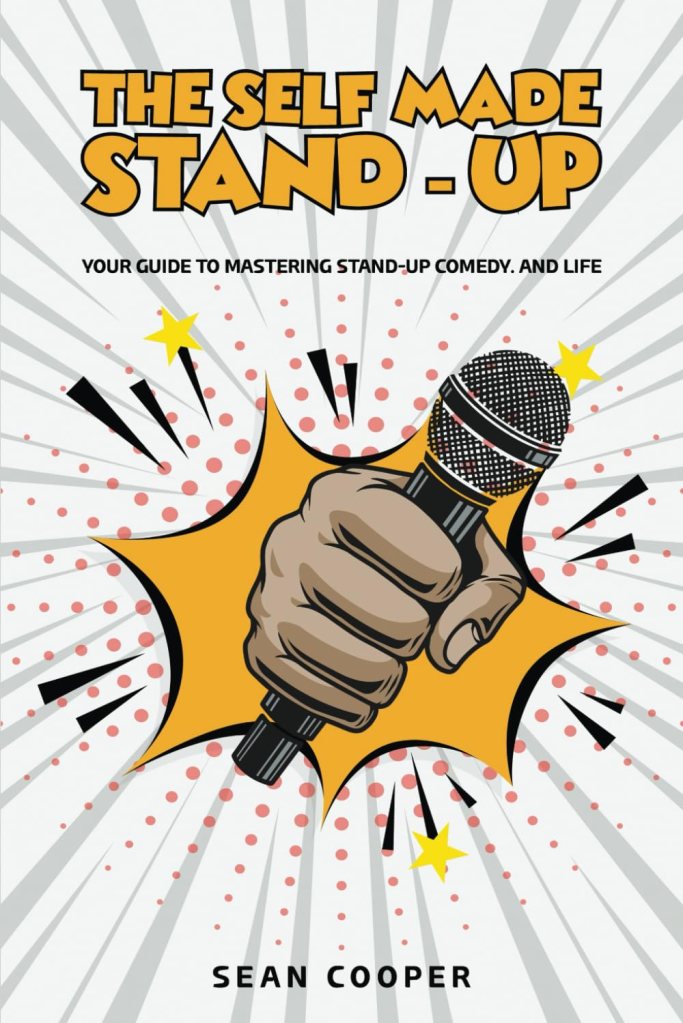
The Self Made Stand Up is available as a paperback or e-book from Amazon, Barnes and Noble and lots of other places.
More than a how-to book, The Self-Made Stand-Up is an essential resource for developing yourself as an effective comedian. If you’re a comedian, or looking to become one, The Self-Made Stand-Up is the emotional support animal you need.
You might want to consider joining my mailing list (I promise I won’t spam you)
 Sean Cooper, Comedian