One of the aspects of live comedy that surprised me the most when I started was it’s flexibility of format. I’d generally regarded comedy performances as a stripped-down and straightforward minimalist process in which a performer talks while we listen and laugh.
Of course I was aware of skits and sketches, comedians who present in a musical format, and the “panel show” structure adapted from TV game shows, so I have to attribute my format assumptions as a personal bias because traditional stand-up performances is what I prefer.
I was one of six first timers on the night of my debut, and one of the other acts brought an easel on stage. By day he did illustrations and caricatures at the local markets, so his presentation incorporated cartoon drawings of stuff while he talked. It was amusing and interesting but I quickly saw reasons this wasn’t going to be a default presentation format for comedians or even he in particular.
The show lost momentum while he set up his equipment, his performance ran long because adding visuals in real time was less efficient than verbal delivery, and he’d invested more energy in delivery than jokes. The show had novelty but it didn’t do better than any of the traditional stand-up, and it might have become this comic’s personal style or brand but they never went further than a second attempt.
Shortly after this one of the local comics who was MC-ing a lot told us that one of of the shows was going to have a big segment based on one of the comedy panel shows in the UK, Who’s Line Is It Anyway. This guy must have thought nobody else had seen the show because he didn’t just rip the format, but copied all the questions and premises for it too. He called all the performers of the night onto the stage to participate in this.
Did it work? Absolutely not. The guy who initiated it tried to make us feel bad for not being as sparkly and entertaining as the show. I explained to him, which probably deflated his respect for panel shows, that those episodes might be filmed and performed live, but they’re scripted.
All the participants know the questions and write their witty responses ahead of time. In some cases, they get their team of hired writers to do it. As for us, we didn’t even know we’d be doing this until it was happening. It was never going to produce our funniest or most entertaining work.
Frankly, I’d never have elected to do that whole exercise if given the choice. I’ve watched those panel shows – fake game shows with no rules, no prizes and no point – but I don’t love them. They might be the best source of revenue for professional comics in the UK but I couldn’t see the appeal for our local open mic circuit.
One of the reasons it wasn’t going to work in Townsville is because the TV shows are filled with celebrities. People tune into Who’s Line Is it or shows like 8 Out Of 10 Cats for the stars that appear on them. Watch a few of these and you’ll quickly realize that everything amusing comes from the participants saying and doing things that reinforce the character they play. I doubt anyone would be much interested in an amateur version of the format.
Celebrity, or lack thereof, is also an obstacle with Roast Battles. This is another comedic format that works well on TV and in established comedy circles. They’re insult competitions that, despite the mean premise, can be a lot of fun. Two comics face off and take turns making brutal jokes at each other’s expense, and it’s judged by a panel of comedians.
The main reason these work, and you’ll see it if you ever see it attempted at a small and amateur level, is that people know the contestants or know enough about them for the jokes to work. It’s a requirement for insult comedy. If I made a crack about Donald Trump or Michael Jackson you’d have to know who they were, or I’d find myself having to explain the joke before I even tell it.
At local roast battles people mostly didn’t know much about us and in many cases we didn’t even know much about each other. The result was an exchange of generic “street” insults that didn’t properly speak to the target of the jokes, and this made for unfunny shows, cruelty without wit. Just a bunch of randoms being snarky to each other in unspecified ways.
Roast Battles are a very specific platform that favours short, sharp jokes with a designated target. The material has to be on point, which is great. It does mean, though, that it’s all you’re going to get. You’re not going to see long-form material, stories, deep reflection or observations about the nature of life and society. The focus is narrow and shallow.
Roast Battles attract edgelords. I once heard a comic say that if you took all of the misogyny, racism and body-shaming out of roast battles you wouldn’t be left with much. I don’t know if that’s a rule, but it’s consistent with most of what I see. While I enjoy watching a good roast in the comfort of my living room, I decided pretty early that these shows would be a bad fit for me and my act.
After the initial attempts to introduce a panel show formal into our local open mic nights, there was a meeting of local comedians and room-runners. They’d taken my observation about the scripted element to seemingly live UK panel shows and decided to create a structured and scripted format for our shows.
The proposition discussed at the meeting was a combination of Saturday Night Live style skits, interactive party games, panel show segments, improv Theatre Sports, songs and surprise pranks on random audience members. In other words, a variety show. As the discussions progressed I was imagining a cheesier and more ribald version of The Muppet Show.
As an event this could work. I can imagine a show like that selling quite a few tickets. I didn’t think it would successfully displace the open mics, and I didn’t love the idea that this vision would become the primary interpretation of our live comedy scene. Most importantly, though, I had zero interest in doing it.
I tried to explain that my interest was stand-up, that I didn’t sign up to act or sing or play crazy party games with strangers. I was happy to support and promote it, but I didn’t enjoy watching this kind of thing and I really wasn’t interested in participating in it. I wanted to be a comedian, not an entertainer, and it just wasn’t the kind of comedian I wanted to be.
I thought that was a fairly uncontroversial position, but a couple of other comics challenged me about this, and I’m still amazed at how forcefully they came at me over it. I was accused of being afraid. Someone told me I need to step out of my comfort zone. Given that, in my fifties, I’d taken the plunge and started doing stand up comedy in front of strangers, I thought that was a weird accusation.
Someone told me I only felt like that because I was so new to it, that after a year or two I’d naturally evolve into that kind of comedy. Nope. Six years later I still don’t enjoy that stuff, and I’m still not interested in doing it.
I don’t know why it was so challenging that I had a clear idea of what kind of comedian I wanted to be. That’s what we should all be doing; defining our own niches and styles. But I digress.
The variety show model never displaced the comedy scene we had. It never really happened at all. There’s a whole thriving drama and theatre scene here with much better training and resources for this kind of format. A better built-in audience for it too.
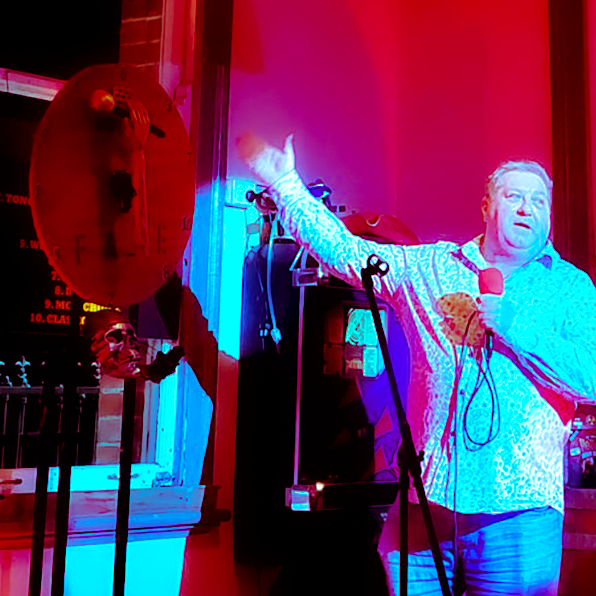
Something that had a little more success was the introduction of a “wheel of fortune” element at one local comedy venue. Before the comic’s presentation they had to endure an outcome prescribed by the spin of a wheel on stage. This would usually be some form of humiliation – drink a vomit-inducing cocktail designed by sadists, eat the world’s hottest corn chips, make chicken noises, get spanked by an audience member, that sort of thing.
And I’m not judging. This is a matter of taste. I think it’s stupid and irritating, but if you think second hand embarrassment and humiliating pranks are premium entertainment that’s an opinion you’re entitled to hold. If you think comedians do their best work while they’re humiliated, choking or trying not to vomit, I won’t argue with you. But an objective salient aspect of these shows is that stand-up is a process of laughing with a comedian and the wheel is a process of laughing at them.
Not the same thing. Those two ideas actually can’t coexist. One of them has to be the dominant theme. And if you imagine that treating a series of performances more like a freakshow leads to rowdier and more aggressive audiences, you’d be right. It might be a legit entertainment platform but I don’t miss it at all.
There are some instances where introducing a game element works really well. Indy C ran some local shows called Crowd Control and these were highly interactive events where comedians responded to unscripted stimuli and audience input. I ‘ve not made it to any of these, but they’re well attended and I hear from both performers and audience members that these are a really fun night.
Right now the biggest influence on stand up shows comes from Kill Tony. I’m not a fan. The only thing I like about it is it’s name. I could talk for hours about how I don’t like Hinchcliffe or his lame interpretation of what comedy is, and probably even longer about how mystified I am that a podcast with a Gong Show format that promises exposure to contestants, gives them sixty seconds to perform and bullies them afterwards. If it sounds lazy and nasty to you, we can be friends.
Nonetheless, it’s popularity is undeniable. Local shows are starting to borrow from Kill Tony. I’ve heard the phrase “bucket pulls” in discussions about updating the format of two local open mics that have already adopted the “No censorship! We’re so edgy!” tone of that show and scene.
This is fine. People are free to design the platform and tone of their shows, and that’s part of the fun. As I implied before, though, I’m not much interested in them. Rooms that adopt a “brutal” tone aren’t a great fit for what I do, and I don’t need wacky games to make it interesting for me. I like stand up comedy. When I see or participate in a night of great stand up comedy, I never find myself thinking that theatrics or fake games would have improved it in any way.
But that’s good comedy. Good stand up doesn’t benefit from artificial activities. Bad stand up does. That’s the thing about the game format – when the content is bad, it’s even more fun. Arguably it’s easier to punch up ordinary content with tricks and gimmicks than it is to lift the quality and appeal of the material. More reliable, too; people who enjoy Kill Tony are guaranteed a show they’ll enjoy regardless of the quality of their performers on any given night.
To be clear – I’m not a hater or a snob about this stuff. I’ve dabbled and experimented a little. I’ve done storyteller shows, comedy debates, crowdwork and stuff like that. My position has always been the same – if you’re trying something different, good for you. But it’s not what I’m interested in watching or performing, and I’d rather focus on writing stuff I think is good than trying to frame it in unconventional ways.
The Self Made Stand Up is available as a paperback or e-book from Amazon, Barnes and Noble, Books.By and lots of other places.
More than a how-to book, The Self-Made Stand-Up is an essential resource for developing yourself as an effective comedian. If you’re a comedian, or looking to become one, The Self-Made Stand-Up is the emotional support animal you need.
 Sean Cooper, Comedian
[…] The great change since has been a new wave of comedy nights, but they’ve all tended to adopt the same strategy of branding themselves as anti-woke, no rules, no-censorship anything-goes fests. Unsurprisingly this tone is often partnered with bucket pulls, an emphasis on crowdwork and elements of gamification. […]
LikeLike