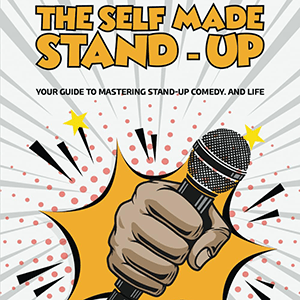
NOTE: This is a chapter from my exciting new book The Self Made Stand-Up, which you can purchase in Australia at Amazon or through Amazon in the US, or from Barnes and Noble, or Books.By – or lots of other places that I can’t keep track of.
It’s a whopping book with 68 Chapters so I don’t feel bad about previewing one of them here. Without further ado…
Edgy Comedy
Jokes that deal with subjects like politics, religion, race, gender, sexuality, disability and other sensitive areas can be very attractive to comedians. Before I started doing stand up I imagined that I might be one of the kinds of comics who favors using edgy and egregious comedy, purely because the comedians I liked twenty years ago were known for that kind of thing.
These included but weren’t limited to Doug Stanhope, Anthony Jezelnik, Frankie Boyle and, Brendon Burns. A lot of comics get the “edgy” label and focus on shock value, and if you do a Google search you’ll find a lot of names I haven’t mentioned here. Like, a lot.
There’s too many to possibly list, and I feel that many of the nominees either aren’t that edgy or aren’t that funny. Obviously it’s a matter of taste. The four comics I listed all deliver challenging premises and punchlines but, more importantly, they have substance. They are all intelligent and funny, and so is their material.
The golden rule, the thing we all learn the hard way, is that your joke has to be funnier than it is offensive. It can be extremely offensive and people will allow it if it’s even more funny. If your joke is funnier we’ll accept the offense because we can see it was an intellectual exercise in humor and it paid off.
This is Benign Violation Theory in practice again. The violation is acceptable if you make it proportionately benign. These are your simultaneous challenges: You destroy and then heal at the same time.
The bigger the destruction the more impressive the healing, and therefore the rewards are bigger. This is why comedians invoke edgy comedy. They are increasing the difficulty level for a more impressive feat and bigger laughs at the end. We’re taking a bigger risk for bigger rewards.
I wish audiences and comedians understood this better. So many people assume that shocking comedy is easier and that the shock does the heavy lifting instead of the humor. People think that “going there” into the territory of offensive and controversial material is a lazy move. They don’t realize that the comedian is actually increasing the difficulty level for a particularly hard maneuver.
The worst offenders for not understanding the true nature of edgy comedy are new comedians. They believe shocking is a short-cut to funny and end up writing offensive material instead of jokes. The misunderstand this so hard that they dismiss negative reactions from the audience.
When the joke fails they assume the audience members are puritans or dummies who don’t understand challenging comedy. Ironically the audience probably understands the “it has to be funnier than offensive” rule better than the performer does.
As long as it’s funnier than it’s offensive, people will laugh. In economics they say that if the perceived value is higher than the price, even if it’s only by one cent, people will buy it. People will always buy if the value is higher than the cost, and that’s the same for jokes.
This rule also has an equal and opposite rule. If you’re a virtue-signalling goody-two-shoes then you need to know this one. Your joke also has to be funnier than it’s preachy. Audiences feel just as violated by a lecture as they do by a grotesque premise.
People don’t mind being challenged, even with their personal taboo topics, if you observe the golden rule of being more funny than offensive and Noble Truth #4, that You Have To Be OK
An Anthony Jeselnik joke: “I’ve got a kid in Africa that I feed, that I clothe, that I school, that I inoculate for 75 cents a day. Which is practically nothing compared to what it cost to send him there.”
Here’s another: “I’ve spent the past two years looking for my ex-girlfriend’s killer… but no one will do it.”
These are deeply offensive and wrong if we think about it, but we don’t because they’re not just funnier enough, but we know they couldn’t possibly be true. Jeselnik doesn’t come across as angry, serious or sincere. His demeanor tells us that the violations are both imaginary and benign, we we interpret it all as bizarre dark thought experiments. Anthony Jeselnik is a master of misdirection and a great example of someone who makes edgy comedy work by always ensuring that the value of funny is higher than the cost of offense.
Doug Stanhope is another comic who’d built his whole persona and career on material that people might find challenging. He’s tackled every controversial topic from abortion to euthanasia, and makes it work by arguing a point. This is the technique of Defending The Indefensible we examined in Counterpoints.
An example is his hilarious “Abortion is Green” bit where he argues that overpopulation is the biggest contributor to our global warming problem. He doesn’t just argue. He shows intelligence, juxtaposing grotesque imagery with sophisticated ideas. He has bit about street prostitution in which he describes disgusting ideas with shockingly gross language, but uses it to illustrate macro-economics theories. He goes through the academic aspect as comfortably as he did with the offensive part of it. His title for this bit is “Keynesian Economic Theory As Applied To Private Sector Independent Contracting.”.
Brendon Burns and Frankie Boyle also trade in challenging and potentially offensive ideas, but they’re also handled smartly. Both of them choose this style to confront us with our own hypocrisy and blind spots. In these instances, our own cognitive dissonance is what makes the violations benign.
Comics who use offensive language for it’s own sake, ones who expect shock and vulgarity to evoke laughs on their own, can find very limited success. They might find an initial easy giggle from an unexpected release of tension, but resistance builds over time and these comedians will struggle to get laughs or respect if they don’t have a point and a punchline that makes it all worthwhile.
Personally, I enjoy being challenged by a comic and I prefer comedy that’s not particularly family friendly. But only if they have a point.
If this all sounds like you need a lot of skill to handle controversial material, you’d be right. Offensive topics are a bit like the exotic and dangerous ingredients chefs might cook with. Fugu, the poisonous Japanese puffer fish, gets a lot of attention for the spectacle of a dangerous meal but only very experienced and skilled chefs can prepare it successfully. Jokes about abortion or assault should be considered toxic and avoided by comedians who don’t have the skill to safely prepare it.
First time Open Mic comics who believe they can make us laugh by copying edgy comedians usually fail. I once heard an experience comedian suggest that new comedians should only be allowed to talk about iPhones and masturbation in their first year, and should have to demonstrate that they’ve developed sufficient skill and maturity before trying their transvestite cat abortion jokes.
At the risk of inviting angry emails comedians who want to educate me about free speech, I’ll offer that I’m inclined to agree with this sentiment. Don’t panic…It can’t possibly be enforced.
But I do believe that the scene would grow and become more favorably regarded if people put the edgy stuff aside until they have the required skill level. I’ve seen too many Open Mic-ers stink up rooms with obnoxious commentary and then depart forever, leaving the committed comedians who actually care to apologize to audiences and venue owners.
Something worth mentioning is that our standards about what’s offensive and acceptable changes over time. 15 years ago we couldn’t say the F word. We still can’t, but it’s a different word now. Before we couldn’t say Fuck but the homophobic slur that starts with the same letter was thrown around freely. These days nobody bats an eyelid if I say Fuck on stage but if I used that other F word I might find myself cancelled and banned from the venue.
We can’t predict what other people might be offended at. The best we can do is to acknowledge that there’s no such thing as an easy laugh, and that potentially offensive material should be handled with great care. Like explosives. Increasing the violation increases the laughter reward and we’ll always be tempted to shoot for the biggest laughs, but we need to be self-aware about our level of expertise.
The Self Made Stand-Up, is available for purchase in Australia at Amazon, through Amazon in the US, or from Barnes and Noble, or Books.By – or lots of other places that I can’t keep track of.


[…] many comics like to go to the other extreme. Edgy Comedy is something a lot of comics want to do, but getting the balance wrong in this direction is a trap. […]
LikeLike
[…] I’ve mentioned before that “edgy” newbies often make two fatal errors: […]
LikeLike