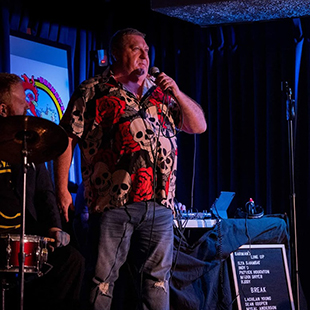
Last night in the green room of Osk Bar, where I was part of another excellent Cocktail Comedy show, the other comics and I were chatting as backstage comics often do.
My friend Liam, who is fast approaching his first anniversary as a comedian, reflected on an observation that might be attributed to Bill Hicks but has become something that all comics observe.
This is the idea that comedy is about truth, that the heart of comedy is truth and that the most artful comedians are really communicating truth – whether it be the truth or just their truth.
I say that, banal as it sounds, it’s salient. I tell him that the longer he does this comedy thing the more that idea will deeply resonate in many ways. I add that it’s not just about the comedian or their message. Feedback for our efforts is immediate, in real-time and it’s brutal in it’s honesty.
That immediate and honest feedback is something I appreciate, even on those occasions when it’s not working in my favour. It’s something I first experienced writing and performing dance music. Other music genres and styles can bluff and claim lofty artistic merit with talk about subjectivity and imply that your inability to connect with it is your shortcoming and not theirs.
Dance music doesn’t indulge bullshit talk like that. It either works or it doesn’t, and your honest and brutal assessment is right there on the dancefloor for all to see. Comedy might be more complex and nuanced, but the principle is the same – we can talk about context and taste, but it’s evaluated only on effectiveness.
For the last few decades comedy has trended strongly toward authenticity, and even comedians who completely fabricate their personas and stories still recognize that our own expression of authenticity is an essential aspect of our artistic evolution.
That’s uncontroversial. Now, let’s contradict it.
Because let’s face it, what we’re doing on stage isn’t exactly the reciting of facts. We’re not bound by an honesty code and nobody cites comedians as sources when in their PHDs.
We are what people expect us to be. We are fabulists. We are authors of fiction. We populate our stories with fictional characters and might even be playing a fictional character ourselves.
At the beginning of the 2006 film The Prestige, a Christopher Nolan directed movie about magicians and their obsessions set in 1800’s England, Michael Caine’s character gives us an overview of how an effective magic trick is structured:
Every great magic trick consists of three parts or acts. The first part is called “The Pledge”. The magician shows you something ordinary: a deck of cards, a bird or a man. He shows you this object. Perhaps he asks you to inspect it to see if it is indeed real, unaltered, normal. But of course… it probably isn’t. The second act is called “The Turn”. The magician takes the ordinary something and makes it do something extraordinary. Now you’re looking for the secret… but you won’t find it, because of course you’re not really looking. You don’t really want to know. You want to be fooled. But you wouldn’t clap yet. Because making something disappear isn’t enough; you have to bring it back. That’s why every magic trick has a third act, the hardest part, the part we call “The Prestige”.”
Does this sound anything like the structure of a joke? It should.
The main tools of our trade are planting false ideas into the minds of our audiences, tricking everyone into getting the wrong impression and then showing people it was an incorrect assumption. It’s a dirty trick, but it’s the heart of what we do.
It’s the secret to how Misdirect Jokes work, but it’s also what we’re doing with Pattern-Breaking jokes. When we’re Defending the Indefensible, Advancing Absurd Propositions or invoking unlikely Analogies we’re knowingly performing the dishonest argument trick of building logic on false premises, pretending to be sincere about it when we know damn well it’s nonsense.
When Chris Rock tells amusing stories about interactions with his wife, he explains offstage that his jokes refer to his “comedy wife” who doesn’t actually exist. And even when our stories aren’t completely made up, they’re exaggerated to crazy reductio ad absurdum proportions. When we rant we’re expressing an outrage we don’t actually feel, as well as any professional actor.
Let’s face it… we lie all the time and don’t pretend otherwise.
It’s not honest, but it is funny.
Most stand-up humour works according to Benign Violation Theory and while we’re often violating people’s values or sense of how things should be, what we violate first is the truth. Some say that every joke has a victim. If that’s true, the first victim is usually truth.
So let’s look at the idea again. Is comedy about truth?
Well, yeah… I think that is is. While we use the techniques of untruth, it’s to guide people to a true idea. It’s a process of using a small lie to communicate a bigger truth. It’s about throwing dishonest ideas around to advance our own truth. It’s exploring the options to help people find their truth.
And if that sounds like a paradox, most aspects of comedy are.
 Sean Cooper, Comedian
Wonderful ♥️
LikeLike