If you follow this blog you’ll already know that I’ve written a book destined for release in the new year. If you’re new, and a lot of you have tuned in after my post about Ludwig Wittgenstein and what comedians can learn from his philosophy, welcome and thanks for coming along for the ride.
For the new people, I’ve got a book coming out and it’s an instructional one about doing stand-up comedy, with an emphasis on how the skills we learn and use can help us win in every aspect of our lives.
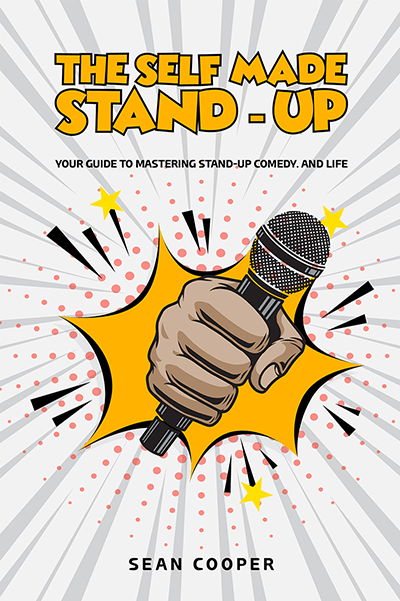
The title is The Self-Made Stand-Up: Your Guide to Mastering Stand-Up Comedy. And Life. I’ve spent a good chunk of this year writing it and I’m proud of the result. It’s exactly what I was looking for when I started doing comedy and was reading every available book on the subject.
Right now it’s in the editing phase. If you haven’t written a book before you probably have the same assumptions about the process that I did. I thought that you write the thing, an editor sends it back with all of your grammatical issues sorted and then you get on with the next step, which is formatting it for print.
Oh how I wish I could get my naive innocence back! If only it were that simple. First, I’ll let you know that there are different types of editors. The type that fixes the spelling mistakes is called a Copy Editor. There are also Content Editors, Structural Editors, Developmental Editors, etc.
Most of those other ones offer coaching about what’s actually in your book; more effective ways to tell your story and stuff like that. Mostly I’m sticking with the Copy editing, because this is not a work of fiction and, as I’m quickly learning, the world of stand-up comedy has it’s own tropes and vernacular that book publishers mostly don’t understand.
This includes silly stuff, like when I’ve had to explain that even though it might be more grammatically egregious, Mic Technique is actually the right phrase. There’s no such thing as “A mic technique” or “The mic technique” in the world of comedy. I’ve had to explain that when I refer to improving your Act, I’m referring to your material and repertoire, and not your behavior. It’s involved explaining that Bits and Chunks are legitimate units of measurement.
Although I’ve opted not to include one, I’m starting to understand why so many books in this genre have a condescending Glossary of Terms. I’ve elected not to do this, just as I’ve elected not to put homework exercises in every chapter. I fucking hate that shit. Who actually does these? Nobody, I suspect. I sure don’t. I feel like putting these things in and pretending it’s a workbook is a waste of space, a bit of a cheat on the part of the author, and a disingenuous way of absolving responsibility for outcomes.
But back to the editing…
As I said, I’d assumed the edit process was a bit like the Mastering process in music creation – the final step where you correct the mistakes, address any issues and mix it for a final professional sheen – and that my part as the originator of the material might be finished.
Nope. It’s a negotiation in which I have to go over it again and do my own editing, accepting or arguing with proposed alterations, finding and fixing any mistakes that they’ve added and a search-and-destroy mission for anything incorrect that both of us have missed in our previous scans of the work.
Then I sent if back to the editor for them to go over it again and do the same after my tinkering. It goes back and forth like this until we both agree that it’s good.
It takes ages. I know that whenever I object to a single thing in a chunk that’s come back to me, and send it back to them, I’ve added another week to the whole process.
It’s also a pain in the ass. It means I’ve read my book carefully, scrutinizing it with far more attention than I usually read with, beginning to end over 30 times. Right now I’m confident I know it well enough to perform it like a nine-hour stand-up set without needing any notes.
I have no idea whether this is normal. It’s my first time. Yeah, I’ve written in magazine publications for decades (about Tarot, mostly) but usually I hand-off to an editor and I’m done. I don’t know if this is how it usually works or whether I’m just being difficult. Every time I send 50 pages back to them with my own notes and corrections, often for the fourth time, I feel like I might be the worst customer they’ve ever had.
The same goes for the cover, for which I sent them my own mockup and rejected their first five renditions of. I also rejected over twenty of their suggestions of Sub Title and eventually ran with my own.
Am I a difficult customer? I have no idea, and I’m keen to hear the perspectives of other writers who’ve gone through this process. In the meantime, even though I’ve made the editors and publishers work much harder than is proportionate to any money they’d ever make from my book, it’s got my fucking name on it so I continue to insist on it being as good as it can be.
Anyway, for an update I’m just going to drop the cover and chapter list here for now. You’ll notice a lot of chapters. It’s turned out to be a substantial book, and the project was bigger than I’d originally planned for.
Part 1: Inspiration
Start Here
Who am I?
Who Are You?
Housekeeping
Your Local Open Mic
Part 2: Philosophy
Three Theories of Comedy
The Four Noble Truths about Comedy
Self Deprecation and Likability
Clean Vs Dirty
Loose Vs Scripted
Comedy Isnt Evergreen
Discontent and Depression
Undeniable
Bombing
Your Act
Part 3: Creativity
Tell me a joke
Setup and Punchline
Units of Measurement
The Misdirect
Cryptomnesia, Parallel Thinking and Theft
Puns
Vemödalen, Premises and Hack
Tags
Knowledge Management Systems
Four Core Attitudes
Word Economy
Storytelling
Rants
Callbacks
Where do ideas come from?
Absurdism and Absurdist Techniques
Topical and Political Comedy.
Getting Personal
Analogies
Counterpoints
Specificity
Edgy Comedy
Shifting Gears and Pacing
Crowdwork
Impressions and Act-Outs
Flipping The Script
Your First Set
Part 4: Implementation
No Barriers
Reconnaissance
Getting Your Bearings
Feng Shui
What to Wear
Nerves
Hosting
Hecklers
Bombing (Again)
Zoom
Rhythm and Flow
Recording
Memory Management, Longer Sets, Repetition
Part 5: Evolution
Explore/Exploit.
10,000 Hours
Social Media
The Problem with Social Media, and the Simple Solution
Photos
Getting Paid
Choose your own adventure
Self Care
The Self Made Stand-Up
I’ll Leave You With This…

 Sean Cooper, Comedian
[…] In my book I’ve written about using the tools of a comedian to process depression, pain, tragedy and adversity. Nietzsche seized upon the idea first. He thought we should interrogate and challenge our assumptions, contextualize violations as benign, and defiantly laugh in the face of difficulty as an assertion of our own existence. He said that the person who masters their life can laugh at “all tragedies, real or imaginary.” […]
LikeLike
[…] their unique voice. Cadence is important but today I’ll be talking about something else. (My soon-to-be-released book has a chapter on […]
LikeLike