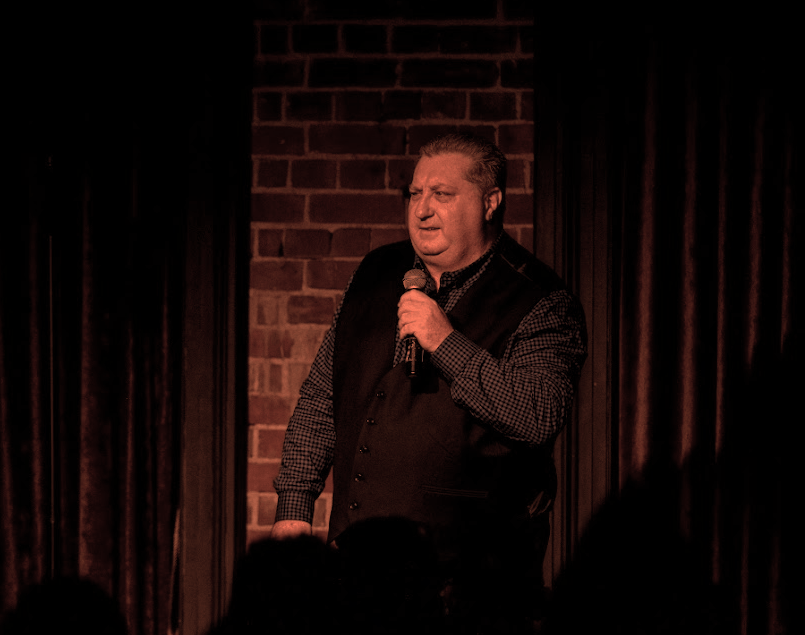
I have peers who suspect that I’ve dropped out of comedy. A couple of them I’ve spoken to lately have asked when I plan to start doing stand-up again. They haven’t seen me around for almost half a year, so I’ve needed to explain that I never actually stopped. I’ve still been doing stand-up and for the last 6 months I’ve actually had more stage time than ever.
They’d be right about assuming I’ve withdrawn from the scene a bit. It’s been 6 months since I did an Open Mic, and those are most of the regular gigs around Townsville. In the last six months I’ve done online shows with Remotely Funny and I’ve been a regular with the Fresno Wine and Espresso Bar.
In May I’ll be at Fresno Comedy on the 4th, and on the 9th of May I’ll be at Sips and Giggles, at the Heritage Exchange. So, yeah. I’m still around…. and I’m actually getting more stage time than ever. This is mostly because they let me go long-form at Fresno. If I want to do 30 minutes, I can.
This is in stark contrast to Open Mics and other forums that can strictly cap your time. Not all of them do… Most of the Open Mic venues have given me a lot more latitude recently, presumably because of trust they invest in performers who’ve spent years demonstrating they’re worth a few minutes of your time.
But also: I’ve mentioned the golden rule of not “running the light” and going overtime enough in previous posts here that you’ll know that Time-Cops are a thing, and that some of them do their policing aggressively (and selectively in most cases).
There’s a lot of good reasons for time limits, and the most selfish of these is that they teach a comedian valuable skills about efficiency and effectiveness, word economy and joke compression. Time limits will turn a meandering waffler carpet-bombing a room with unfocused half-baked ideas into a formidable hitman who routinely kills with well-placed surgical strikes. With every artistic platform, limitations make you better: Comedy is no exception.
What we don’t talk about, ever, are the problems that arise from aggressively capped time limits. I’d like to briefly discuss some of them
Firstly, the obvious one: Short tight sets favour short-form comedy. You give ten comedians the challenge of a two minute set and you’re going to see all of those comedians doing one-liners and puns. Some wacky voices, maybe a little physical slapstick, sure, but mostly dad-jokes.
The time limit excludes any chance of long-form idea exploration, complex riffing or the sophistication of developing themes. The comedian who only gets a couple of minutes won’t bother writing these, and will have to lean heavily on puns for their survival.
So, yeah, time limits can improve your focus, but they can also stunt your growth.
Secondly, Short tight sets exclude audience interaction. I’ve already told you that I’m not a huge Crowdwork guy, but I’ll never deny that interacting with your audience is an important skill to have.
Stand-Up is the only artistic platform without a “fourth wall.” Sure, live theatre kinda talks to us through the fourth wall, but we don’t talk back. The theatre play is pre-written and there’s no space in the script for audience input. With Stand-Up Comedy, there’s an expectation that the audience can speak and the performer has the prerogative to turn that into a dialogue for a bit.
This kind of performance won’t be done by people with tight time-frames though. When I got a strictly capped 5 minutes, my challenge was to say what I needed to without going over and incurring the ire of my peers. 300 precious seconds with which to make my point… was I going to throw half of them away getting into a squabble with a drunk random?
Fuck, no. You need the luxury of time to initiate unscripted conversations onstage. I had some peers saying I should do crowdwork, but they were the same ones aggressively policing my time. Lots of them were focusing on MC-ing which seems to be immune to time, and they’d happily waste lots of minutes chatting with the audience.
MC-ing isn’t the only way to do it though. Fresno is a tiny venue that doesn’t have a stage and leaves the lights on for performances, so anything anyone in the room says is heard by everyone else and becomes part of the show. And now that I don’t have to worry that the meter is running, I can happily acknowledge and explore audience interjections in a relaxed and comfortable way. I’m never going to be a big Crowdwork guy, but I’m really enjoying the ability to respond and work with what happens in the room.
Third, Short tight sets make us obsessed with LPM. I’m talking about Laughs Per Minute, which is definitely a thing. We should all care about LPM. It’s the most reliable estimate to measure if you’re any good, especially at the start. And increasing your LPM is the most reliable way to improve your act. If you’re in your first year of comedy and ask me for advice, there’s a very good chance that what I tell you will be some version of finding a way to increase your LPM.
But is LPM the whole story? Fuck, no. And obsessively pursuing LPM at all cost makes you a tiresome comic. The two most reliable ways of pushing your LPM numbers up are one-liners, puns and tagging. These are all ways of getting more laughs in less time, so we all try to implement one of more of these into our acts.
Tagging is amazing. Letting us get more punchlines from the same set-up? As many as four or five punches from a single set-up? That’s great value!
Except everyone’s getting sick of it. Don’t get me wrong – I love tagging and do it all the time. But over-extraction is a thing and after a decade the constant tagging thing is played out. People are starting to get irritated with constant over-tagging, and it looks desperate to try and milk every single possible chuckle from a joke.
The thing I learned when I was DJ-ing is the importance of pacing and breathing space. If you DJ a 2-3 hour set you naturally want everyone to be hyped and experience exciting climactic moments, and you’ll probably aim for keeping the excitement level high for as much of it as you can.
But that’s not what your audience want. It’s what they think they want, but it’s not what they really want. Truthfully, no dancer wants to stay at maximum manic climax energy levels for three fucking hours. They need breaks. Also, your climaxes are established by contrast. You can’t just keep turning up speed and volume. You have to lower the intensity so you raise it again and establish climax through contrast.
Same for LPM with Comedy. Even LPM master and one-liner legend Jimmy Carr has been talking about wanting to introduce some long-form material into his act. He knows that an hour of rapid-fire high-LPM one-liners gets samey. There’s no room for climaxes.
High-LPM sets are actually draining. We need the highs and lows to get our breath back. If you watch the comics you revere the most, the ones you emulate and respect, you’ll find that they’re generally not full-throttle LPM machines. They know that comedy works on pressure-and-release, and that’s what they master. LPM-obsessed comics who never get to work on sets more than 5 minutes long will never get the chance to master this skill.
Short tight sets leave no room for experimentation. All comedians do (or should do) lots of A/B Testing. We substitute words, try variations of sentences, etc to see what’s the most effective. We’re obsessed with finding out the most powerful way to articulate something and getting the best results. We’re constantly balancing what we know against what we can learn to make our jokes the best they can be.
Unless we’re on the clock, that is. With 300 seconds slipping away as fast as sands through an hourglass, I’m not experimenting much. I’m focused on safely making the most of my few precious seconds and I’m not going to be spending any of them on research.
The tragedy of enforced efficiency is that we never end up with happy accidents. Short sets limit experimentation.
Finally, Short tight sets make us unprepared for long sets. I’ve spoken before about transitioning to longer sets but it’s still a big deal going from 5 to 15, or 5 to 20, or more. It’s big gap to Evel Knievel over.
Oh sure, you might have 20 minutes worth of material from your short sets, but you still don’t know anything about the structure of longer sets. Short sets don’t need structure. They need jokes. But try to hold up ten minutes or more and it’s going to sag in the middle unless you install some structure. Twenty or more and people could eventually feel lost if you don’t have a road-map and destination.
These are things I’ll probably talk about in a future post. For now, my only point is that regularly doing 2-5 minute spots doesn’t prepare you for the challenges that come with longer ones. When I was regularly doing 5 minute sets, I had no idea how strong people’s urge to check their phones is at the 13 minute mark. Now, I plan for it and structure my sets accordingly.
Sprinters have very different challenges to endurance runners. Sprinters don’t have to worry about pacing, keeping resources in reserve, hitting the wall or outstaying their welcome. They come in with explosive power, which is it’s own skill and definitely something you need to master before thinking about marathons.
The 5 points I made don’t get talked about enough. Short tight set skills are essential… but all they prepare you for is, at absolute best, a tight 5 on a late night show. They’re not enough to do a special or a one-person show or a headliner set, or to hit the road with. At some point you’re going to have to work out how to find more stage time to learn the skills that longer shows teach you.
For my own purposes. I found that doing short sets means doing more of them and I was burning myself out doing lots of Open Mics.
In Malcolm Gladwell’s book Outliers he argues for the “10,000-Hour Rule” which claims that excellence has only one real ingredient, which is 10,000 hours of practice. He cites examples like The Beatles and Bill Gates as ‘proof’ of his argument and doesn’t even seem to notice the irony of his book title: An outlier is a statistical anomaly that defies rules. Outliers don’t prove rules
But Malcolm still offers up rare weird exceptions as proof of his practice makes perfect claim, even though the axiom is pretty uncontroversial and shouldn’t need any proof at all. Yeah, not a fan. If you need the 5 richest people in the world to prove something that’s supposed to apply to everyone, maybe it’s not actually a rule at all?
Whatever… All I know is there’s very experienced comics (10,000+ hours) I’m never going to like or enjoy, and there’s newcomers who I believe are superior in every way. Obviously practice and experience matters, but you won’t correct doing it wrong by doing it wrong more. Endless Grinding is no substitute for intelligence and creativity and actually having something to say.
But I digress. What I’m challenging (and this is something I’ve discussed before) is the notion that all gigs are good gigs and that you have to take every single gig. I’ve also held this idea, that you have to get out there and say yes to every single opportunity. I got some experience, but with it came a ton of burnout.
Burnout crept up on me at the end of last year. Big time. Yes, I will dedicate a special post specifically to burnout because it and the subsequent mental health consequences take on a very specific shape in Comedy. But yeah, comedy burnout fucked me up. It fucked up my creativity, some of my relationships in the comedy scene and threatened to start making it’s presence felt in the other areas of my life.
This hustle culture idea that you’ve gotta get out every single night for years has some value for comics who are young and committed to making it their singular vocation. It might be true but that’s not my situation; I already have a demanding and emotionally draining day job and lots of other commitments.
The open mics are all on weekdays, which usually start at 5am for me, and racing from home to walk the dog and get ready and race back in was exhausting. The price of 5 minutes onstage was a tiring 20 hour day, and lots of them were barely worth it. Some of these venues weren’t getting audiences and hanging out at them felt like it was more about negotiating local scene politics than anything to do with self-improvement.
The people running the Open Mics sent the message that we had to attend and support them regularly to be considered for any curated shows. Some of these rooms, the ones who didn’t seem to have audiences at all, were inexplicably increasing the frequency and going weekly or more. Also, other new rooms all over town that we’re all expected to support!
At the time our local scene was down to just a handful of us, including some relative newcomers who haven’t developed much material yet, so it felt like it was being stretched a bit thin. Actually that’s a pretty big understatement.
As for me, I needed to get off the content-provision treadmill. I was doing 20+ hour days several times a week, getting less than 4 hours sleep most of the time, constantly running from checkpoint to checkpoint and expected to deliver 110% everywhere I go. Even the feeling of running late 24/7 was doing my head in.
When could I actually write new material? Maybe everyone else was OK with doing the same material to the same tiny audience night after night, but I didn’t think the situation was rewarding or sustainable. We didn’t have the supply or the demand to keep opening new rooms and double the frequency of the existing ones, and I had to ask who it was all for.
It was fucking me up in every way and that was starting to show in every area. I had to step back or the comedy and the day job would suffer. So I did.
But like I said, I’ve still been around. Fortunately Fresno let me do long shows, gives me as much stage time as I want, regularly. Every few weeks, and not after a stressful work day, I get to do as much stand up as I’d get in a month of Open Mics, and I get to develop the long-form skills that I never got the opportunity for. It’s going pretty well and I’m enjoying it a lot.
I think I’ve improved over this period, but a lot of curated shows evaluate a comic on how many open mics they support than their merit, so I’m probably not going to get those opportunities unless I get back on the treadmill and put my nose to the grindstone in support of a bunch of open mics on life support. And that isn’t going to happen this week because I still really need the rest, and I don’t need it. I already have a day job and I have no illusions about becoming an overnight millionaire in comedy.
But again, I digress. My intention is not to whine about my burnout and pitch it against an expansion of the local scene that I don’t understand. I just wanted to put a couple of long-standing assumptions into context, now that I can weight in on them with my own perspective.
These are (1) the assumption that ultra-compression and time restrictions are only a good thing, and (2) the idea that constant and endless repetition of the same limited thing for 10,000 hours is automatically going to make you excellent.
Both have some truth but neither is the whole truth. They combine to make a specific formula for interminable process of exercising a very small and specific muscle group without any regard for the other muscles that need to be developed – or the injuries you can sustain from repetitive strain.
My advice for ambitious comics is to step back occasionally. Keeping your nose to the grindstone isn’t good for your creativity, your material or your mental health. And work out a way to get some stage time in more relaxed sets too, because you also need to learn that.
 Sean Cooper, Comedian
Interesting reading! I’ve never really thought about the issues a stand-up comedian faces regarding “time caps” and “crowdwork”. I’m intrigued now. I’ll be back to read more. 🙂
LikeLiked by 1 person
[…] ago I hit a wall where I was seriously burned out and it was manifesting in some not-great ways. I’ve written a little about it, but I needed to get off the open mic […]
LikeLike