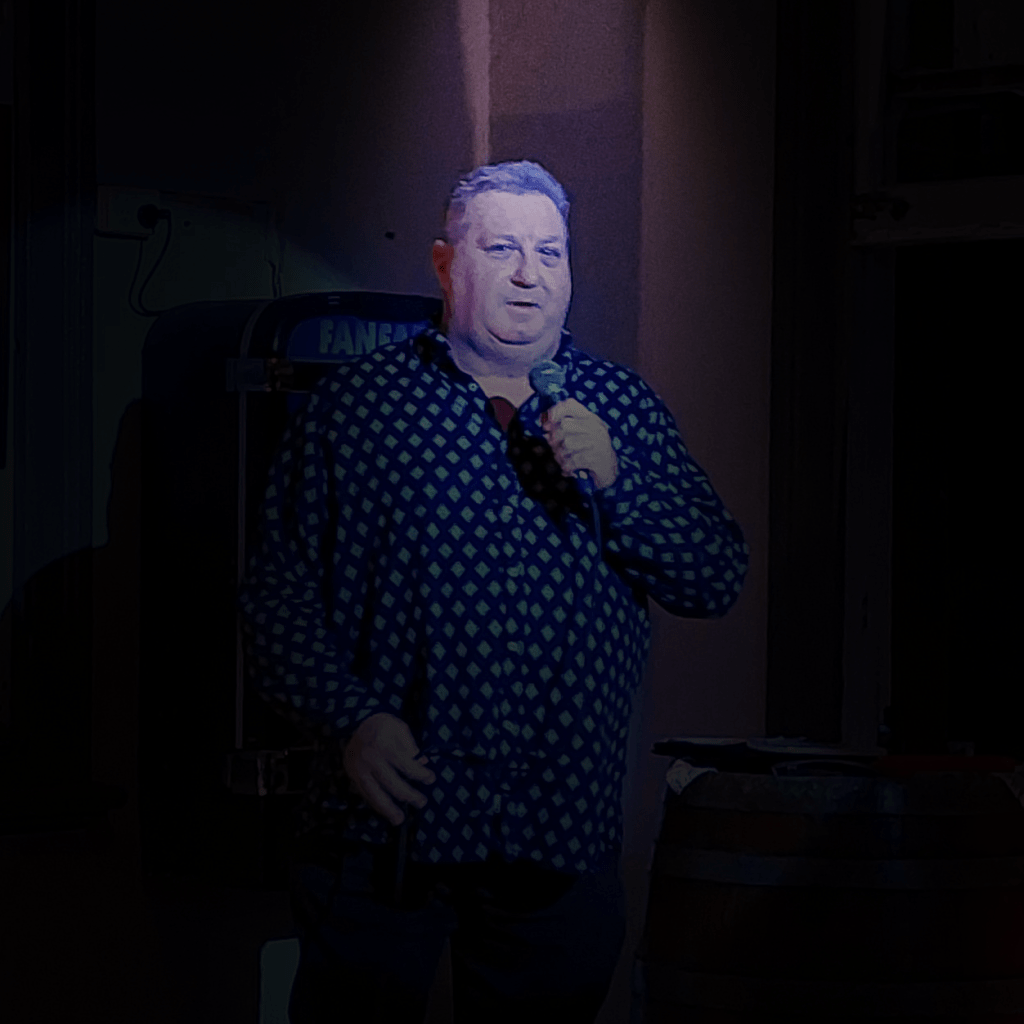
My friend Patrick Haughton and I did our very first open mic at the same venue on the same night in 2019. There were six first timers that night but Pat and I are the only ones of that group who actually became comedians and are still going. We instantly recognised each other as a potential comic so we paid attention to our respective journeys and compared notes along the way.
We had different strengths, though. Patrick was charismatic, comfortable and a natural performer. I most definitely was not that but I think my material was pretty good for a novice (even if it makes me cringe now). Our first six months’ development was a balance: playing to our strengths while working on our respective areas for improvement.
Something that happened to Patrick, though, was that he was offered a professional show, supporting Matt Okine, almost immediately. He was instructed to polish his act. He was told to not introduce anything new, but keep presenting the same material over and over until it was show-ready. He dutifully followed this and on the big night you’d never have known how new he was.

I should have done the same. I really needed to work on the performance aspect. Instead, I was more obsessed with writing. The result? Every time felt like the first time: I wasn’t confident about the material. I was stressing about constantly memorising my sets and I lived in a permanent state of wondering if it was any good. I was ignoring the task of becoming a good performer.
Taking stock of our respective positions, I presented very much like a first-timer but I had a decent catalogue of sets with potential (who knows? I hadn’t yet done justice to any of them) and Patrick had become a likeable confident performer with a single set that he’d repeated so often even he didn’t want to hear anymore. The instruction to not try anything new had left him well established but without sufficient material.
I guess ideally we both should have balanced our attention between developing material and working with what we had, and that’s how we both spent our next six months. Our extreme positions gradually converged.
For the record though, I have since learned this: The most important attribute you have have in your first year is Likeability. If people like you, can relate and connect with you, they’ll see your potential and overlook a lack of stock. They’ll want you to win, and they’ll cut you a lot of slack. If people don’t find anything to like about you or your act, it barely matters how much of it you’ve got. You’d have to be the most incredible comedian in the world to overcome being unlikeable in your first year.
Well, that’s hindsight for you. Anyway, the moral is you’ve got to focus on developing your act as well as perfecting it, and thanks to the Likeability principle, you’ll propably want to prioritize the performance aspect. That’s the ideal path that both of us wish we’d been able to follow.
This isn’t just a comedy principle. The dilemma of whether to Explore to increase your knowledge and resources, or to Exploit the knowledge and resources you’ve got is a real thing. It’s called, funnily enough, the Explore/Exploit Dilemma and it’s a concern to Game Theorists, Economists, Business Managers and Entrepreneurs, Financial Advisors, Artists, Governments, Designers, Product Developers, and pretty much everyone.
Imagine you find yourself on a desert island and there’s a small amount of fruit nearby. You could maybe survive on that, but if you risk your safety and energy to explore you could find something more substantial. You might even find a means of escape. Is that something you’ll leave the safety of the fruit for?
Math people use the example of the Poker machine that’s paying out a small amount in regular increments. You have finite tokens to stick in the machines, and you have to ask yourself how you’re going to budget between the safe, small paying machine you’re on or maybe one you could hit a jackpot with.
Truthfully, Explore is critical. You’re going to slowly and surely run out of tokens if you don’t. The world changes and your companies’ “safe” strategy will get blindsided by an innovator if you’re not careful. Likewise, the comedian who keeps repeating the same routine will find it’s becoming less effective over time.
But completely abandoning your safety net for risk, forgetting the information you have, dropping what you know works… that’s probably not going to end well either. It’s important to Exploit what you have, the knowledge and resources you’ve worked to get. A Comedian who completely ignores material that they know people like will find themselves perpectually at square one, without being able to use what they have proven.
On one hand, comedians should always be writing. They should always be A/B Testing, always optimising and improving their material. It’s essential. If we don’t, our act goes stale and we wither away.
On the other, we really need to work with what we have. Pro comics in Master Classes have warned us against introducing too many untested elements into our routines. This is good advice, even if I’ve traditionally shunned it. I recently saw an established comic, one I really admire, bomb hard with new and untested premises and jokes (although I laughed – I could see what he was trying to do).
I’ve always erred on the side of Explore. Part of it’s been guilt and fear, not wanting to be accused of rehashing and recycling the same old material. I really had a strong taboo about repeating something, and I’d set myself a 6 month limit on doing the same set again.
This was silly of me. For starters, not everything I’ve written is equal in quality. And I’ve done myself a disservice by always being nervous and always detracting from my performance with a memory challenge. Experienced comics save that shit for open mic nights, but I was treating every show like an open mic. Also, I wasn’t evolving any of my existing material, not giving it the chance to be developed and shown properly.
This year I’ve vowed to change that.
Good thing too, because 2023 has been chaotic and demanding in many ways, and I haven’t had the time or the creative juice (whatever that is) to churn out lots of new stuff. Instead, I’ve worked on my existing material. Exploiting what I’ve already built.
It’s gone well. I can’t tell you how much easier it is to do stuff that I can remember, how relaxing it feels to work with material that I know is good. The jokes themselves have been getting their first chance to shine properly, presented in a practiced and professional way.
And my stage presence has improved markedly since I’ve been able to take my eyes off the (metaphorical) map and focus on the (metaphorical) driving. I’ve been lucky enough this year to headline a few times, and for each of them I’ve demonstrated the kind of mastery (if I do say so myself) that you just can’t get without practice.
Sure, I’ve felt guilty and anxious about my writing output. Every jester in the world worries that they’ve maybe written their last joke. And even the most crowdwork-focused comic (I’ll be discussing crowdwork in a forthcoming post) needs an actual act if they want to do proper shows and not just short algorithm-friendly “Comedian destroys heckler” clips on Instagram and YouTube.
I feel like I should be writing more jokes, but I’m glad I’ve focused on working my actual act in 2023. It’s been a good developmental year for me in that respect. Of course there’s been new jokes. But I’ve introduced them gradually and organically, as the professionals have advised me to. It’s taken me four years to find the optimal balance between Exploit and Explore, and when people talk about how long it takes to become a good comedian, I feel like resolving this particular dilemma is a big part of it.

 Sean Cooper, Comedian
[…] with finding out the most powerful way to articulate something and getting the best results. We’re constantly balancing what we know against what we can learn to make our jokes the best they can […]
LikeLike
[…] means repeating it, but there’s no getting around the need to bring new content to the table. I’ve mentioned the explore/exploit conundrum here before, but I’m feeling lately like we need to be a bit more brutal with the material we […]
LikeLike