
Advice for novice comedians? It’s everywhere – books, internet articles, YouTube videos, courses and peers with experience all offer information about getting up and running with comedy.
There’s lots of information sources but not much actual information because there really isn’t any substitute for what you learn by actually doing it. Later on there’s plenty of rabbit holes to disappear down (such as why some letters sound funnier than others, why comedy is more successful in cooler temperatures, what are the most effective colours for rooms, etc) but what you’ll be interested in at the beginning is actually writing jokes and performing them, and the tips will be mostly the same everywhere you look.
There’s a tip I can guarantee you’re going to hear many times, and that’s mostly because it’s an extremely effective one: Open with a self-deprecating joke based on something observable about you.
The reason this is great advice is because the joke is a triple threat:
- It’s a quick way to get a laugh early in your set (the thinking is that you’ll be more successful if you can get one within 15 seconds)
- It acknowledges the “elephant in the room” (the thinking is that people won’t be able to concentrate on your other jokes until you acknowledge the visible distraction)
- It makes you more likeable (the thinking is that being more likeable makes people more receptive to your jokes)

I’ve done it and I can tell you it really works. It works so well, in fact, that an awful lot of comedians do it. I’ve seen a crazy number of comedy shows and specials, listened to countless comedy albums and everyone’s doing it.
This is why, just over a year ago, I referred to the tactic as a bit “hacky.” A few of my peers took umbrage to this, so I’d better explain that “hack, derived from hackneyed doesn’t mean bad, it just means overused – “to make common or frequent use of” – and in comedy we view that as kinda bad. I defend my statement. It’s an effective technique but it is commonly and frequently used, too much so.
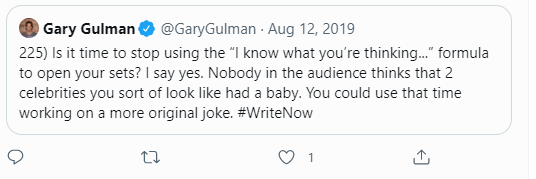
These days. I try not to use self deprecating humour (I do it just enough that my offended peers imply I’m some kind of hypocrite when I do). I’ve got a few reasons including #1 It’s overdone, and here they are.
#2 It’s Off-Brand. When you start comedy you’ve got some decisions to make about the kind of humour you do and the kind of comic you’ll be. Will you be absurdist? Political? Will you be yourself or speak through character(s)? Will you work “clean” or “blue”? Cocky or self-deprecating?
As you keep going with stand up you realise how important is is to establish these characteristics and be consistent with them. If you take your kids to see a clean politically correct self-deprecating comic you enjoyed, and this time they’re arrogant and racist – constantly dropping F-Bombs you won’t be happy. You’ll lose trust in that comedian and you’ll lose trust in live comedy, which is even more tragic.
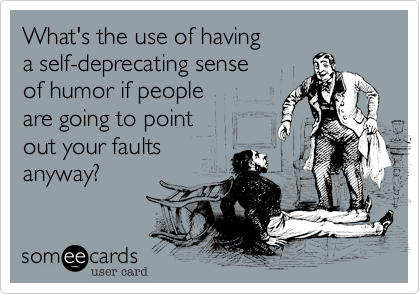
I made the decision early to go for authenticity. Partially it’s the kind of comedy I prefer, partly because I’m more interested in self-expression than being a chuckle factory, also because I’m too lazy to constantly switch between alter-ego and secret identity. Authenticity means I’m not doing exaggerated arrogance or pretending fake humility for the rest of my comedy career.
That brings me to reason #3 It’s not honest. False modesty feels insincere to me. The assumption is that people are more “likeable” when they self-deprecate but I don ‘t think I’ve ever liked anyone more for putting themselves down. I find it draining. Tiresome. Like someone’s fishing for compliments or trying to make things awkward. When you tell me you’re flawed/inferior/worthless/whatever but you’re saying it while showing me that you and your message are important enough to to get on stage with a mic and expect me to listen to you, I feel like you’re a fucking fraud.
It feels fucking insincere. I try not to engage in bullshit false modesty or passive-aggressive self-deprecation, I don’t have patience when other people do, and I’m not interested in play-acting fake humility for the rest of my comedy career.
#4 It’s not healthy. It sounds counter-intuitive because in the comedy world we love to say it’s healthy to not take yourself seriously, it’s healthy to put shit on ourselves and each other. That’s true up to a point, and it’s really untrue beyond that point. But first, some very important context:
You probably shouldn’t listen to comedians for mental health advice. Comedians are literally the worst mental health role models in the known universe.

I love comedy and comedians but most of us have absolutely no business telling anyone what is and isn’t “healthy”. When I see a comic lecturing people about mental health, it occurs to me that their funniest material is ironic and unintentional. (One notable exception: Gary Gulman. His special/documentary The Great Depresh is excellent).
Obviously, we could all afford to take outselves less seriously. Obviously irreverence has tremendous value in society. That’s a foundational tenet of comedy we all agree with.
But if you believe in affirmations at all you’d be reluctant to say shitty things about yourself night after night. Regularly reinforcing the belief that people like you more when you say shitty things about yourself doesn’t sound like a step towards “healthy.”

It’s rarely the surgical strike you think it is. You think you’re targeting an individual but you’re attacking a category. The “pro tip” is that I grab the mic and make a joke about my weight. That’s easy. Cheap laugh. Except I’m not just attacking myself. It’s a fat joke told by a fat person – it targets all overweight people in the room (and outside it).
If a woman comes on and says she’s worthless because she’s a woman it’s not a “self deprecating joke” it’s a mysogynist joke told by a woman. The idea of comics roasting themselves on stage, attacking others who are just like them, and self-flagellating for laughs from an audience who’ll only like them more if they put shit on themselves isn’t any example of “healthy” that makes sense to me.
#5 I think it’s 99% bad. I’ve actually heard some really funny and clever self-deprecating jokes, but (like horror movies, cigarettes and dates) I’ve got to have 300 bad ones to have 3 good experiences. Therefore, 99% bad. It’s personal, of course. There’s many types of comedy: I know what I like and what I don’t.

Roast jokes don’t excite me much. Roast jokes just don’t have the things I love in comedy (speaking truth to power, challenging norms, making us think differently about things we take for granted, putting big problems into perspective, revealing insights through frivolity, etc). Roasting yourself doesn’t make the joke any deeper. I didn’t get into comedy because I had aspirations to attack myself in public with dumb zingers.

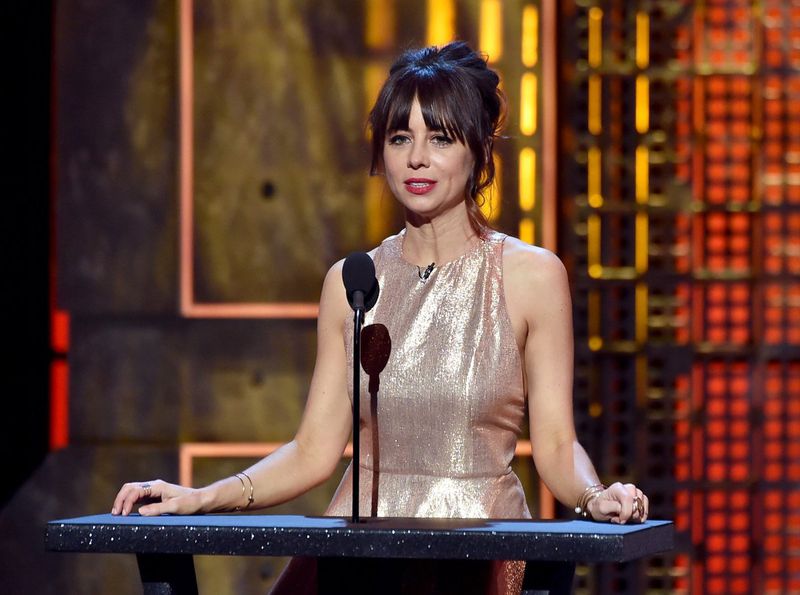
Even comedians who excel at roast humour like Anthony Jezelnik and Natasha Leggero don’t love self-deprecating jokes. They both discuss it on this episode of his podcast and Jezelnik describes self-deprecating jokes as a crutch, a cowardly maneuvre for people who want to express mean-ness without seeming mean, taking shots at the one person in the room who’s guaranteed not to argue or fight back.
I feel that if you want to see someone acting inferior you probably don’t want to see a comedian – you really want to see a clown. And if you need other people to put themselves down for you to like them more – you actually want to see a shrink.
Self-deprecating comedy works. I’ve tried it and know it’s effective. I personally find it distateful. These are my reasons why I don’t enjoy it or rely heavily on it.
I know people (comics, mostly) who react very strongly to some of what I write here. They respond as though my opinions were inflammatory, controversial, political and significant. They’re really not. They’re my ideas and preferences. You have those too. But your feelings aren’t a good reason why I shouldn’t have mine. Put them in your own blog instead 🙂
.
 Sean Cooper, Comedian
[…] boxes, pandered to locals in the area, did more puns and one-liners, avoided challenging material, did more self-deprecating jokes, talked about sports, dumbed-down my act, smiled […]
LikeLike
[…] in 15 seconds (but you’d better get everyone’s attention in the first 15 seconds). You don’t have to flagellate yourself with self-deprecation to make people like you. I’ve written that our word economy, while important, shouldn’t be so aggressive we cut […]
LikeLike