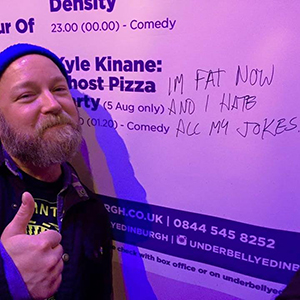
Today I want to talk about Kyle Kinane and look at his most recent special, Dirt Nap. If you know me, you’ll know that Kyle Kinane is one of my favourite comics.
I like a lot of comedians but there are just a handful who’s new release I get really excited about. Kyle Kinane is in that list. I’ve seen or listened to all of his releases many, many times.
Dirt Nap is nearly a year old and I remember thinking it’s good but probably not my favourite and didn’t listen again for a long time. I actually thought I remembered it pretty well, too well to listen to for at least another six months. Now, I wonder what kind of mood I must have been in when I initially heard it, because I gave it another go this week and it’s fucking excellent.
Cutting myself a bit of slack, I’ve noticed that I do this with the specials I’m really excited about. I watch them as soon as I can, which is not necessarily when I’m ready to. If I had the discipline to wait until I can properly appreciate and enjoy it, I’d love the journey a lot more. But if it’s one of those rare specials I’m too keen for, I’ll probably watch it at a time that’s sub-optimal and it won’t catch me like it should. I think that’s what happened here.
So let’s talk about Kyle. Comedians don’t have formal character classes like Dungeons and Dragons does, but if they did, you’d probably class Kyle Kinane as a “storyteller.” This is what people described me as in my early phase of doing comedy. I’ve since learned that this label is a double-edged sword. It acknowledges positive qualities about the comedian such as likeability, relatability, and a relaxed approach.
But sometimes “storyteller” has some negative connotations. It’s seen as easy, lazy even, compared to what traditional comedians do. Most comics are trying to tell a story with every pair of sentences, and their craft is to concentrate that so powerfully that they can get up to 20 powerful micro-stories in a 5-6 minute set. Comedians can view the storyteller as the worst kind of comedian – one who disregards the important doctrine of Word Economy and seems to actively do the opposite.
The other reflex we have when we see someone go into “I’m gonna tell you a story” mode is that we’re going to see someone who’s not very funny. That might sound like an unfair prejudice but we’ve seen enough unfunny self-described comedians at open mics to tell you that we’re being perfectly fair in our reaction.
This is because a lot of newbies make false assumptions about storytelling comedy. They think that, between the jocular tone of a “good yarn” that’s built into stories and the additional context that comes from a narrative form, there’s less pressure to be funny. They look at the epic task of creating a “tight five,” a powerful short set that delivers as much bang for the buck as can be packed into 300 seconds. A lot of work, a lot of writing, a lot of testing and a lot of time go into developing a “tight five.”
Then they compare it with telling an amusing five-minute story. They figure that it’s a much easier task and the result is roughly the same. In fact, they’ll proudly hold their head up, feeling that the relatable bond and easy delivery of a “good yarn” is equivalent to the 4 laughs-per-minute guy, that their set is maybe even more memorable and relatable.
And yes, there is something to this. Crowdwork comics and other performers who emphasize the “banter” acknowledge the truth that easy and amiable connections have value, sometimes superior value. The comedian who turns up with 15 one-liners will look like they’re performing, but the one who engages in relaxed exchange and delivers their material in a relaxed format looks like a performer.
Famous and respected trial lawyer Gerry Spence tells us in his book How to Argue and Win Every Time that we’re a storytelling species. We’ve been communicating through the medium of story since caveman times. Even prior to writing, every important lesson has been passed down this way.
Gerry tells us that if you’re trying to convince a room full of people that Temu-brand car tyres are bad and dangerous, reading a list of damning statistics and hoping that people will invest the effort of interpreting the data correctly is possibly the worst and least-convincing method you could use. Most likely, everyone in the room is going to tune out. That’s the worst kind of death for a lawyer trying to win hearts and minds, and it’s equally bad for a comedian who’s trying to win everyone over.
Gerry recommends telling a story, painting a picture of a loving and responsible mother who does everything right. She ensures her children, to whom she is devoted, are safely and properly harnessed with seat belts and high quality car-seats for the youngest. She’s left for their school play ten minutes early to ensure that there is no risk and no rush. She drives responsibly, as always. And she engages with her children in a conversation that demonstrates a deep familial bond and lets us know they are good, relatable people. She’ll make plans for later, deciding to take some photos of young Luke’s first stage performance to show and discuss with dad when he gets home.
And then, a threat. A reckless driver speeds through a red light and into the path of our protagonists. She has moments to calculate and employ a correct response. From her many hours of defensive driving training, she applies the correct grip and angle to the steering wheel and pumps the brakes with the right amount of pressure. This is a potential disaster, but mum has invested everything into making sure that she and her children are safe.
Or so she thought. She trusted the recommendation of the mechanic when they got their quarterly tyre replacement, but she had no way of knowing he was trying to cut corners and used Temu-brand tyres instead of the usual brand he’s always installed before.
And the tyres fail. Instead of the graceful slowing and avoidance that her strategies should have employed, the inferior tyres caused a skidding straight into the path of the malevolent speeding machinery. What should have been a scary story over dinner is now a life-altering tragedy with heartbreaking outcomes for everyone…
And that’s how you persuade a room of strangers. With a story. Never underestimate the power of story.
But you have to do it right. Hang around open mics and you’ll see it done wrong a lot, by performers who didn’t understand the format and hoped that the story framework would do all the work for them. Let’s take a look at what some of the errors are.
The first thing a comedian needs to understand is that Word Economy still matters. Often stories are chosen by comics who either don’t want to do the work of concentrating their material for extra punch. Even more frequently the “storyteller,” like comedy newbies, doesn’t understand the game.
I can tell someone doesn’t understand the game when they tell me that one of their jokes or stories can be extended or stretched out if needed. Newbies think the challenge is filling up five long minutes. Experienced comics know the challenge is having to pack all of their ideas into a mere 5 short minutes.
The newbies stretch their stories into bloated meanderings that test everyone’s patience. They don’t appreciate that all of the word choices comedians make to emphasize the punchlines apply even more when you’re going long-form. So they travel the longest distance between two points of beginning and end, presenting backstories we don’t need to know, articulate their sentences in inefficient ways, add unnecessary detail, and act like someone’s paying them by the word.
They’re not, by the way. Nobody’s paying you by the word. Even if the currency is approval and laughter, we’re paid better for using less words. If you have any potential as a comedian, you’ll work this phenomenon out pretty quickly in your career.
Something else to understand if you’re going to be a storyteller, is that the Story isn’t the point. It’s the platform. Lots of newbies think the story is the joke, like a one-liner/misdirect but longer. If this were true, you’d want to avoid stories at all costs. Who the fuck thinks they’re going to ‘kill’ with only one joke? If you want to kill, to utterly dominate a comedy crowd, you’re going to aim for about 20 laughs over your alloted 5 minutes.
You will probably not get there at first, though with skill you could possibly exceed it. But if you’re treating your five minute story like it’s a joke, you’re going all-in on one laugh. You better get that laugh, and it better be a fucking good laugh. Because one laugh per five minutes is objectively a terrible and unacceptible ratio.
If you tell 5 one-minute stories the best you can possibly do is one laugh per minute, which is also fucking bad, though most people aren’t going to shame you for getting five good laughs at an open mic. If, that is, you get the laugh for every single story. To analogize this to gambling, it’s still a bad bet. You’re risking everything on a bet where failure is likely and the maximum optimal outcome still isn’t very good.
If there’s a “Golden Rule” of comedy, it’s that you have to make a profit. The reward always has to exceed the investment or you have failed. The investment can be time or credulity or patience or emotional reaction, and the reward is always laughter.
This means that you can be offensive, but the joke has to be funnier than it is offensive – or you lose.
You can test people’s credulity and ask them to suspend their disbelief, but the joke has to be funnier than it is bullshit – or you lose.
It means you can be preachy, but the joke has to be funnier than it is preachy – or you lose.
And most importantly you can ask people to invest their time, but but the joke has to be funnier than it is long – or you lose.
This is the Golden Rule and all comics need to know it. You’re going to ask your audience to invest in your jokes, and you have to deliver a profitable return on their investment or you lose and people will stop wanting to invest in your act.
Even if you do five one-minute stories you can’t possibly win if you treat the story as though it is the joke. you can only increase that LPM ratio by understanding that the story is not the joke. Your story is a platform, a format, a delivery device for all the actual jokes that you have. It’s a framework that you can squeeze jokes into.
Comedians know that there’s two parts to a joke – the setup and the punchline – and that the setup is necessary but requires invcestment (time and cognition) for no payoff, so it’s a necessary evil. If you deliver your jokes inside a story, that story will do the setup work. If you do it well enough, it means less setup for each individual joke.
If you also consider you’re not re-setting to zero by starting a new story/setup for every joke and the storyteller who actually gets it will be delivering a more powerful and efficient set with a higher LPM ratio than the one-liner guy. one-liner comedians go for the most laughs per minute, but nearly all of them underestimates the cognitive load of those frequent resets and how that diminishes the effectiveness of the jokes over time.
A skilled storyteller comedian understands that their story isn’t the joke, but a framework that can store lots of jokes in it. They will try to squeeze something funny into every single sentence of their natrrative. They will see every single line of that story as an opportunity for a tag, a pun, a barb or a callback. They don’t all have to have room-destroying potency, but the sum of the total will be bigger, and keeping the laughter level constant ensures no momentum is lost. When you’re telling stories, losing momentum is your enemy.
Something else storytelling comics, and good comics of all types, will understand is that the Premise is not the Punchline. Your premise, what the joke’s about, is usually built into the setup of your joke. It;’s not meant to be funny. The Punchline that follows is the funny bit, and usually the funny comes from the way it juxtaposes with the premise.
A fatal mistake that many new comics make is they think they can get an edge by choosing a funny premise. They think if the joke is about something funny, it will be funny. The result is often they neglect the all-important punchline because they think their zany premise already did the job. If they do include a punchline, it’s weakened and undermined by a premise that tried to compete with it.
Examples? Sure.I’ll start with the unholy trinity that is the open-mic loser starter pack: Prostate Exams, Stool Samples and Incontinence. I’m sure you’ve seen a comedian try to be funny with a story about shitting their pants, collecting their shit for a medical test, or a doctor sticking a finger up their arse. I know I sure have, countless fucking times. And it’s never funny because the comedian confused their setup and punchline, trying to make a premise do the work. Oh, and it’s hack bullshit.
I have a theory that this is why Impressions have gone out of vogue even though we probably have more skilled impressionists and our celebrities now invite pardoy more than ever. When someone says “Here’s an impression of George Clooney getting pegged by a gang of angry priests,” that’s their premise and the combination of voice and dialogue that follows is supposed to be the punchline.
And it very rarely is. Even if the impression is spot-on, it’s hardly the punchline which was already delivered in the exposition at the beginning. The impressionist has tried to treat their premise like a punchline, and all it did was undermine their punchline by giving it away early. The result is a setup that needs a setup, and a punchline that never really arrives.
Smart comedians know that the premise is not the punchline and little is ever gained by trying to make the premise the funny bit. In practical terms, it means a skilled comic might deliver a very mundane seup and then drop a punchline that twists it unexpectedly.
To translate this to storytelling comedy, putting all of your ‘zany’ into the narrative and expecting it to be the joke is a mistake that can only really get you a possible maximum of one laugh. The story is not the joke. It’s a delivery device for jokes. Making it zany and expecting that to do all the work isn’t going to get you the results you seek.
A wacky yarn isn’t a cheat code that lets you bypass joke-writing, so stop being a lazy hack. A story is nothing more than a device to deliver a a lot of jokes. Every single line is an opportunity for a barb, a pun, a tag or a callback. So write the fucking jokes.
Importantly, and this is something you’ll see in Kyle Kinane’s act if you examine it critically, is that every story needs lots of on- and off-ramps. This is a concept you can only learn with experience, so don’t beat yourself up if it takes a whole to get it.
What if people aren’t vibing with your narrative? If you realize, 30 seconds into your 12-minute “That time I ate the wrong mushrooms before a job interview” story, that the audience doesn’t seem willing to come along with you on that epic journey. This could be the beginning of a disaster, a 12 minute-long slow-motion car crash that might generate a whole new story called “The worst time I ever bombed on stage,”
My martial arts sensei used to have this whole philosophy about commitment. When you step off the footpath and onto the road and see a car rushing towards you, do you jump back, run forward or freeze? Knowing yourself and choosing the tactically optimal optimal over your innate kneejerk reaction will save your life, he used to tell me. You have a similar choice when you’ve started a storytelling journey that people might not follow you for. Do you brace yourself, lean in and hope for the best? Do you try and transform it and best it to the needs of the moment? Or do you cut your losses and abort the mission, switching to something else?
You need experience to recognise the predicament in the first place. You need more experience to make that instantaneous decision effectively in real time before a live audience. Experience will also tell you there’s pros and cons with every strategy. Aborting isn’t a guaranteed save if some people are invested, and you end up looking like you’re throwing your own material under the bus. But experience will also teach you that you need choices in moments like these.
Two critical skills to develop as a comedian are:
1. To build your bits like an accordion, something you can expand or contract. There should be a “Theatrical Release” which is the basic engine of your bit – with all the most effective features and parts that you can use in short sets and in front of impatient crowds. But you also have to build a “Directors’ Cut” edition with all the additional commentary, deleted scenes and even alternate endings for when it’s more prudent to go deep and epic.
2. To build your bits like a superhighway with lots of entry and exit points. With something like this, you can jump on in several places, and you always have spots to exit the superhighway if it’s not the best place to be. Once you learn the power to build bits like this, you can do clever things like leave the superhighway and take a scenic detour and re-enter the highway at another point. You start to see that these entry and exit points are potential connectors where you can seamlessly segue between bits. This is a level-up from just writing jokes, and it makes everything you have far more effective and useful. It takes experience aqnd skill to do this, so it’s not going to happen straight away, but when it does you have bits that can be gracefully discarded at the exit points, It will save you in situations where a bit isn’t working as well as you’d hoped.
These two attributes are essential for effective storytelling, where you’re using exit points and expand/contract abilities to make sure your story lands, or seamlessly turns into something more effective when that doesn’t look likely.
And that brings us back to Kyle Kinane, because he enriches his stories with scenic detours and tangents. It’s part of what he does, packing in laughter-opportunities into every moment. But these detours, as well as enriching and elevating basic stories into epic bits, are also connection points that give entry and exit options.
Aspiring storytellers who think believe it’s easier and better to tell a good yarn than deliver lots of jokes need to study Kyle Kinane.
Sure, he’s a storyteller. But more importantly, he’s a skilled writer who employs clever word choices and uses every opportunity to optimise every line for humour. And it’s hard not appreciate the tactical approach he takes to designing bits with connectors. It’s a hallmark of a masterful comedian, and I would encourage you to approach his specials with a critical eye so that you can appreciate his craft and learn from it.
Revisiting Dirt Nap and appreciating all of the smart flourishes he works into all of it, I realised I had to urge all prospective storytelling comedians to watch and study it. It’s a very enjoyable special, and a fucking masterclass for storytellers.
I’m enbedding it below but ff you don’t want to watch it all on this page, check out Dirt Nap with this link.
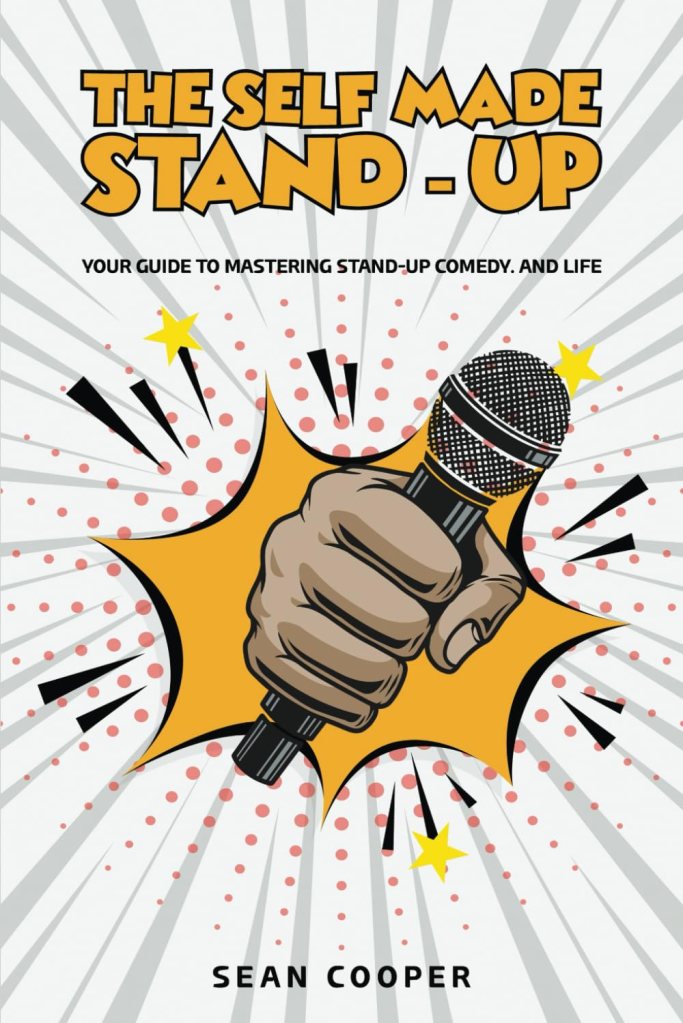
The Self Made Stand Up is available as a paperback or e-book from Amazon, Barnes and Noble and lots of other places.
More than a how-to book, The Self-Made Stand-Up is an essential resource for developing yourself as an effective comedian. If you’re a comedian, or looking to become one, The Self-Made Stand-Up is the emotional support animal you need.
You might want to consider joining my mailing list (I promise I won’t spam you)
 Sean Cooper, Comedian