
When I was planning my book (The Self-Made Stand-Up) I intended to put a lot of emphasis on finding and developing your own voice as a comedian. I believe it’s one of the most essential areas to work on as a comic, easily as important as learning to write and tell jokes because it’s the lens through which all of your material will be developed.
I made a strong case for finding one’s own voice and talked about how to identify and develop it as well as I could, but if there’s any aspect of the book I wish I’d done better (besides choosing a better editor) I’d like to have given clearer and better instruction for that very important component to the development of a fully formed comedian.
I’m being a bit harsh on myself and my book, of which I am still extremely proud. Understanding where you sit on a scripted/unscripted spectrum, thinking about whether you will work clean or not, whether you’ll be low or high energy, and many of the other considerations I discussed all go a long way toward establishing and developing your voice.
I discussed the importance of consistency to that voice and emphasized that one’s voice and “brand” has more value than any joke is worth, and that learning the worth of your brand will incline you towards rejecting any material that underlines it—even if it’s funny.
I’d like to do something that I didn’t explore in the book, which is looking at voice from a developmental perspective and reflecting on my own experience as a comic and knowing other comics’ journeys. As I rapidly approach a seventh comedy birthday, I’ve reflected on on how my own development progressed and analyzed the evolution of some peers who started about the same time I did.
Comedians tend to have a competitive streak we’re not especially proud of, and engage in more comparison than is good for our mental health. Sometimes this is even while we’re advising not to and offering better philosophies.
I’ve enjoyed reflecting on my journey and the journeys of my immediate peers. It’s given me an insight which I’d not considered, which is that there are some developmental milestones and experiences that we’ve all shared regardless of our individual styles and success levels.
My compare and contrast also reveals mistakes we’ve all made and some examples where development seems to be arrested. For that reason I’ll withhold identifying any of my examples as much as possible in a small scene. Spoiler alert – all evolution of skills in writing and performance are, in my not-humble opinion, intrinsically linked to the authentic and consistent process of finding voice.
My own path doesn’t have too many crazy plot twists, but some themes emerge that I see reflected in the journeys of other comics. Expectations have risen over the years. I remember my biggest request from my first stand up experience just being that I survived it. I’d be ok if I could not “die” on stage and walk away unscathed. That was all I felt qualified to hope for. I should probably remember that for perspective because my expectations about how well my act is received tend to be a lot higher these days.
In terms of premises, I intuitively gravitated towards topics I now regard as lightweight. My first set had jokes about burritos, dating and television remotes. It’s not exactly A Critique of Pure Reason. but I can now see that I was wise not to punch above my weight and to choose topics more suited to the meager skill level that came with my neophyte status.
The trajectory would start with lightweight fluff about burritos, 18 months of coasting on easy material about dating and drinking before overcorrecting and trying to make everything too weighty and deep and focus on being too personal and oversharing. I was writing about life itself, which is far too formless and generic to properly define or do justice to.
I was tackling topics like marriage and politics and mental health, mostly to see whether I could make any of it work. The answer is that I could make quite a lot of it work, but not all of it and not to everyone. I learned the very hard way that punters at comedy shows don’t always enjoy presentations about macroeconomics or depression, no matter how witty they may be. I had some of my biggest wins and most painful bombs about three years in.
This all settled as I eventually wrapped my mind around the idea that specific is both preferable to and funnier than the general. This is a simple but profound insight I wish I understood sooner. Talking about a specific person or thing to imply a wider truth about a category is better than the other way around. When you talk specific to imply something general, you avoid all of the pitfalls that come with preachiness or disagreement. That’s the simple version, but there’s so much more about that idea that I’ll have to cover it in a future post. I wish I’d learned that trick sooner.
These days I’ve implemented that idea by also discussing mundane ideas and implying larger and significant concepts that are analogous. That’s actually been my main writing strategy for the last couple of years. I’ll be talking about the hassle of wall mounted EFTPOS machines but really trying to say something about the social implications of technology.
I’ve also grounded my performance to a more restrained or moderate voice. When I thought about becoming a comic my favourite comedians were edgy, provocative, outrageous, offensive and downright obscene. I didn’t feel confident to present that in my first performances, which I just wanted to get to the other side of without ruffling any feathers. I assumed I’d get braver when my skill and confidence built up.
That didn’t happen for a long time. I did pretty well for a newbie in my first year, but I decline to congratulate myself when I realise I was playing it very safe. I was too fearful to remove the mic from it’s stand or move around on stage for a long time, so you can imagine I wasn’t fronting any controversial opinions or bold performative gestures. I wasn’t engaging in risky conversations with interlocutors from the audience. I’m actually a bit disappointed in myself when I reflect on how fucking long I stayed risk-averse for.
But I’ve developed a bit of a theory in which I liken doing stand up to driving an automobile. You know how learning drivers test everyone’s patience on the road with their timidity and inability to commit to a course of action? Yeah, I think many of us are like that for our first 12-18 months.
And then comes the P-Plates. I’m sure other countries have the equivalent of Provisional Plates given to drivers when they graduate from that learning phase. P could also mean probationary, and there are speed and conduct limitations (such as a 0.000 limit for alcohol) applied, with losing any driving rights being a consequence of noncompliance.
I’m also assuming it’s widely recognized that, ironically, the P-Plate driver is the most overconfident and non-compliant driver on the road. Most of them are extremely dangerous, speeding everywhere, swerving all over the place with no signalling of intent, behaving aggressively to everyone else on the road, and no visible acknowledgement of the rules that constrain the rest of us.
Sadly, I don’t view P-Plates as second-year apprentices who are developing in the right direction. I treat them as an obnoxious and dangerous liability, drivers who strongly overestimate their own limited skills, aggressive and indifferent to how they’re ruining everyone else’s experience. They have a lot less control of what they’re doing than they think, and don’t seem to realise that nobody thinks they’re cool or that we’re all actively avoiding them until they fucking grow out of it.
What do comedy P-Plates look like? just like that. Don’t make me labour the analogy.
For the record, I also had a comedy P-Plate period. I don’t think I was too bad with it, but there was definitely a period after 18 months in which I cranked up the edginess and employed more “shock and awe” into my routines. I’m pleased to say that my transgressions never involved any kind of T.R.A.S.H (transphobia, racism, ableism, sexism or homophobia) but I sure did get some DMs and emails from people who misunderstood me.
Again, this is a normal development phase. Finding your voice will mean trying a few things to see if they fit. I am dismayed, however, when I see that some of my peers are still P-Platers after several years. My expectation is that after the original shaky period, which is all about getting confidence and learning the basics, we have a phase of P-Plate wildness, which is all about trying stuff and seeing what fits, finding out what we can get away with, and where the lines and boundaries are.
After that, I expect comics to have worked out who they are and what they do, which usually means settling into themselves. I’m confused and dismayed when I see comedians with 3+ years’ experience still trying to find out what they can get away with. Everyone’s got their own timeline and we can all take as long as we want to learn who we are and develop our own voices, so feel free to take as long as you like.
But remember: getting good in comedy takes an unreasonably long time, and you don’t really start until you’ve worked out what your own authentic voice is all about. If you spent too many years fucking around on your P-Plates you might not get the chance to experience any real progress before you give up.
How do we do it? Well, going through those phases is a start. You need to learn some basics, then you need to test some limits, then you need to try some stuff on and see what fits. We all go through it and it’s a good start. But there’s more.
As I’ve already mentioned, having a think about the different style spectrums and working out where you sit on each will be a good start. Ask yourself some of these questions:
- Do you feel more affinity with writing or performance?
- Are you more comfortable with “dirty” or “clean” comedy?
- Are you keen for crowd work, or do you prefer more structure?
- Do you want to present as your authentic self, or develop a persona/character?
- Are you more inclined for high energy performance, or low energy?
- Are you comfortable with straightforward spoken-word performance, or are you more interested in other forms of the genre like music or magic tricks?
- Are you insterested in short-form material like one-liners or long-form material like stories?
- Do you have favourite themes like relationships or politics, or are you happy to talk about whatever’s funny?
Have a good think about who your favourite comedians are. Because there’s a strong chance you’ll sound just like them for your first 18 months. Mark Normand’s high esteem for Jerry Seinfeld might come as a suprise to many, but not anyone who saw him in his first year. He’s said in interviews that he never realised how much he was trying to sound like Seinfeld until come of his peers teased him for it.
It’s inevitable. When I was playing guitar in high school bands I sounded like a shitty unskilled version of my favourite guitarists. Even though I didn’t adopt Doug Stanhope’s dellivery, cadence or level of controversy when I became a comedian, I can now see what I borrowed and copied – his heavy use of adjectives and colourful word choices to add flavour and emphasis to descriptions, as well as using lots of personal anecdotes. I can tell who some of my friend’s favourite comics are just by the way they hold the microphone (one in particular looks like Shane Gillis with someone else’s head).
We won’t even have any space for our own voice to develop in if it’s inhabited by other comedians. It’s important to identify our influences, I’ve already discussed that this year, but it’s worth repeating. Know your influences, acknowledge them, then put them where they belong so you have space to grow your own act.
Another thing you’ll was to examine is your Sorge. I’m borrowing the concept of Sorge from Heidegger, that brilliant but problematic philosopher. It feels relevant, since Nazism appears to be in the rise again. Sorge means concern or care. It’s what you’re about, what matters to you, what your values are.
If we were anthropologists trying to understand ancient or alien civilizations, our best approach might be to ask what is their Sorge. Understanding someone’s care, priorities, values and interests is an excellent tool to understand their behaviours and systems. Arguably, it’s a useful tool for life and something sorely needed in the world right now.
To understand Sorge in a context of comedy, it’s linked to premises. Take your favourite comedian, go over their specials and albums and look for themes. What ideas do they keep returning to?
People think of Doug Stanhope as “edgy” or “offensive” but that completely misses the point. His Sorge is extremely Heideggarian, because his recurring themes are being true to oneself (Heidegger would say authenticity), embracing life and living in the moment (what Heidegger would call Dasein) and extreme individualism – Stanhope famously said, in defence of drugs and tattoos and suicide and bad life choices, that “you own your own meat! If nothing else, you own your own meat.” Having a look at Doug Stanhopes’ Sorge it would suprise nobody to hear that he ran for President of America in 2008 as a Libertarian.
Looking at his body of work from a Sorge angle gives a better insight to his act and material than superficial stylistic observations. It’s also helpfiul for understanding why Stanhope is a modern comic legend even though there’s a million edgelord copycats all trying to emulate him.
Looking at his act through a Sorge lens will help you understand how and why he writes the jokes that he does. Looking at yourself through a lens of Sorge will help you understand how you write your own jokes and decide what they’re about. What matters to you? What do you care about? What would you fight for? What would you risk for? What would you speak up about? Heidegger might say that’s who you really are.
Your Sorge will define your voice. It’ll help you choose your premises, write your material and guide you in how to present it. It’s tempting to think of it as navel gazing introspection, but it’s really a booster that’ll help you write strong, authentic and consistent material and develop your act.
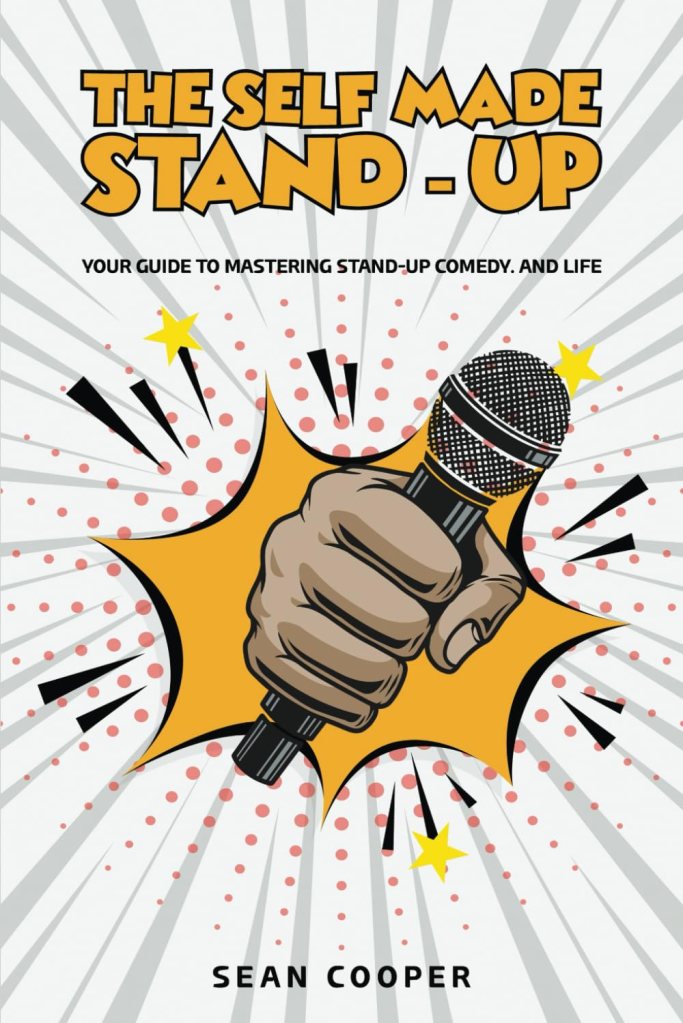
The Self Made Stand Up is available as a paperback or e-book from Amazon, Barnes and Noble and lots of other places.
More than a how-to book, The Self-Made Stand-Up is an essential resource for developing yourself as an effective comedian. If you’re a comedian, or looking to become one, The Self-Made Stand-Up is the emotional support animal you need.
You might want to consider joining my mailing list (I promise I won’t spam you)
 Sean Cooper, Comedian