
Plotter or Pantser? These are the main types of people who write literature. Some meticulously plan their novels (Plotters) while others like Steven King talk about the magic of writing as they go, just as delighted to see where the characters and circumstances take their stories to as the readers will be. These writers call themselves Pantsers because their process is “flying by the seat of their pants.”
Comedy has a parallel polarity. Some of us are tightly Scripted while others like to perform Loose and incorporate a lot of improvisation and interactive crowdwork, never certain of where their narrative will go to.
I’ve discussed this before. Today I want to discuss some of the mechanics of plotting, the craft of writing jokes and the sets they appear in. When I find myself discussing the writing process with other comics, there are two pain points that come up consistently. These are writing the jokes, and creating the “big finish” for the set.
Novelists have equivalent problems to solve and one of the best pieces of advice given to them also works for our discipline. This is to reverse-engineer their story; to think of the ending they want first, and to work backwards from there to the beginning.
There are a few reasons why this is fantastic advice. Pantsers, who begin with characters and starting points and make it up as they go along, typically find themselves falling for a few common traps. The most common of these is realizing they’ve painted themselves into a corner. Not thinking enough about their destination can result in a narrative cul-de-sac that’s impossible to return to a main story from.
Problem number two that pops up for writers who don’t plan their endings is the threat of anti-climax. Plotters start with the big finish in mind and build up to it. Pantsers sometimes find themselves in the unenviable position of having written a whole novel before finding out it doesn’t have a great finish. Imagine spending time and effort to get to the end of the rainbow, only to find there’s no pot of gold there? The writers in this position have to patch together a pot of gold and hope nobody senses that it was hastily contrived and not part of a consistent vision.
Pacing is the third challenge for improvisers. Just like a house where someone just started building at one end without a blueprint, it’s probably going to look chaotic and it will definitely sag in the middle.
A common problem with people who write in this way is that they give the protagonist too much virtue or power at the beginning and aren’t able to show progression during the narrative. Imagine if Harry Potter started his first book with the powers he has at the end. You’d miss out on what people love most about the story, which is discovery and learning and accessing knowledge and abilities and wisdom as he goes.
Don’t get me wrong; I still have lots of problems with the Harry Potter books. Like how they’re all written from the perspective of the least interesting character in that world. Or how someone can literally learn magic and still need glasses. Or why an institution with truth spells and serums even has a court system, let alone a corrupted one. Or why anyone would want to live in a universe where a fucking hat tells you who you are. And so much more… but I digress.
The point is that Harry Potter does one thing extremely well, and that is the way it gradually expands it’s lore and knowledge, how the protagonists progressively increase their powers and maturity, and how the threat level consistently rises. This is because JK Rowling plots her stories with the same passion that she hates trans people with. If the Harry Potter stories were made up as she went along, they’d be a mess.
You can tell she’s started at the end and worked backwards, because there is so much talk of prophecy and foreshadowing the final showdown even right at the beginning. People enjoy the ride, but they only stay right to the end because there is one and it promises to be big with the assurance of someone who knows what it is.
Comedy is funny because both extremes get praise. When someone’s making it up as they go along, doing a wild and unpredictable verbal Road Trip with destination unknown, we’re dazzled. It’s like a magic trick and the comic who pulls it off looks like a mercurial genius of whimsy.
But I’d argue that we’re really impressed – much more impressed, in fact – it’s when the comedian reveals that there was a master plan all along, that no matter how much we appear to be improvising we’re actually playing four-dimensional chess and skillfully revealing an architectural masterpiece.
This is one of the reasons why the Callback is such a successful technique. It suggests structure and a master plan (even if we all know that deploying a successful Callback is actually a lot easier than it appears). Sometimes a comic might look like they’re riffing for forty minutes, but then enter a stretch where all of the random threads are woven together and their audience realizes that there’s been cohesive themes and through-lines have been at play all along. This is the shit that critics go wild over and audiences rave about. I’d suggest that it’s more impressive to people than an ability to ad-lib.
How to we write something like that? By working backwards. The Pantser will start at the beginning and not know how it ends, but the Plotter does the opposite. They’re more likely to think of an awesome conclusion and work backwards from there to discover where it starts.
Strangely, comedians who use a lot of puns know how to do this best. They will start with two words that sound similar, or a word with two meanings, and then construct a story that leads it it. Punsters instinctively know how to reverse engineer and start at the end.
Reverse engineering is a useful practice to work on. It helps write jokes, it helps optimize our set structure and shows people there’s more going on than a bunch of gags. It doesn’t just help us write the big finish to close with; It guides us to the best starting point as well.
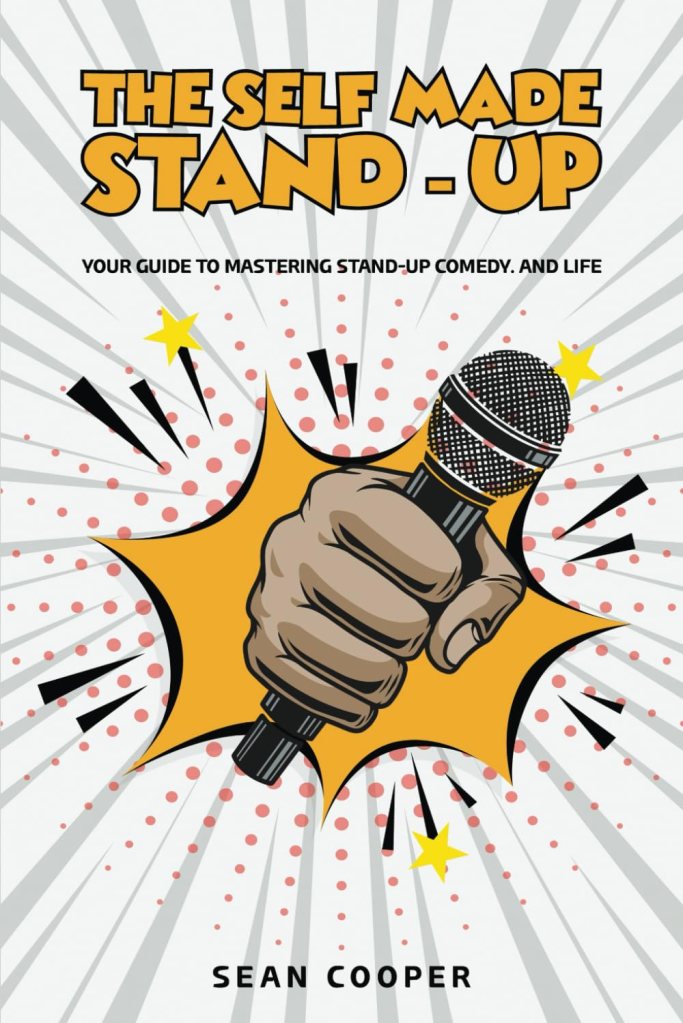
The Self Made Stand Up is available as a paperback or e-book from Amazon, Barnes and Noble, Books.By and lots of other places.
More than a how-to book, The Self-Made Stand-Up is an essential resource for developing yourself as an effective comedian. If you’re a comedian, or looking to become one, The Self-Made Stand-Up is the emotional support animal you need.
You might want to consider joining my mailing list (I promise I won’t spam you)
 Sean Cooper, Comedian