AI. You’re sick of it. I’m sick of it. We’re all sick of it. When it’s not being wedged into parts of our life we never needed it it in, we’re being asked to get excited about it by a bunch of crypto-slinging tech-bro billionaire grifters. Either that or hearing the militant grievances from artists and other workers who’s role and income it’s busy stealing from. If there’s one “news” update I’d like to see permanently banished from my personal newsfeeds it would be tough to choose between every petty thought, utterance or misdeed from Elon fucking Musk or the latest half-formed idea from everybody about A-fucking-I.
AI is a bit like Spotify and it’s competitors. We know it’s evil, we know it creates wealth by actively funneling money away from the people who actually create the original product… but it’s an ideological position that doesn’t change much. As outraged as people might get, most of us still use those streaming services without a second thought.
Full disclosure: I’ve done some stuff with AI. Pictures, mostly, because sometimes I need images. I’m neither an artist nor a wealthy patron of the arts. I hate 99% of AI imagery just like you do, and I hate the way it’s used to fake stuff even more. But it has it’s place. I’ve written in defense of generative imagery before and I stand by most of it.
Here’s the thing: Most of the haters open their arguments with their personal belief about what art is – and reveal to me that they’re not qualified to have serious debates about it. You don’t want me to go on about it here, so I’ll just make this one point – ever since Marcel Duchamp wrote a name on a urinal and put it in a gallery, nobody’s really been able to make the claim that art is defined by how much blood, sweat, tears, time, study, effort or expense went into it’s creation. I might have the same gut feelings you do, but I’m still waiting for a valid argument before I repent.
We’ve had hundreds of years to get used to machines replacing our physical labour. We’ve had more than half a century to adapt to the idea that computers doing the same thing with a lot of our intellectual labour. Five minutes into the AI situation, we probably can’t be expected to love seeing machines closing in on the emotional and creative work too.
When it comes to the other kinds of artists that AI threatens, music and writing, I don’t bother. I’ve done music, and have a back catalogue of sonic work that I’m pretty proud of. My agenda with Alternate Parallel Reality was to humanize electronic music. I was surrounded by peers leaning into the whole futuristic machine music, ready to embrace the Singularity and loving the whole computer consciousness aesthetic I was doing something different. I wanted to explore emotion and existentialism what it means to be a human, and actively avoided that whole ‘robots are cool’ thing.
So, as you might imagine, I don’t love AI music. I don’t even like it when people make music in a paint-by-numbers way, so I can’t even imagine a universe in which I’d enjoy anything made by a Large Language Model. Maybe I could if I heard some that wasn’t shit, but everything I’ve heard so far is utter shit. At best it’s cynical pragmatic cosplaying of humanity, faking emotions like a psychopath. No thanks. I only know one person who dabbles in it and I’m far from impressed. It sounds professionally produced but there’s no energy, no passion, no insight and no inspiration. Mind you, most of the songs preach toxic conservative political views, complaining about woke comedy and dinky-di Aussie jingoism, so I’d probably think it was complete shit no matter how it was composed.
And writing? If you want to deeply offend me you can ask me if I used AI to write my book. I didn’t and wouldn’t. I can write. And I think I write better than ChatGPT does. I can’t compete with the speed it generates large volumes, but AI can never do insights and original ideas better than I do.
You can’t go to AI for an original idea. It’s job is to synthesize what’s already out there. That’s literally how it works. It’s never going to come up with fresh ideas of it’s own. The only reason AI gets so much play in people’s university assignments is that these institutions actively discourage original ideas and insist that we can prove through citation that everything we say was already said by someone else. To my thinking, that’s a systemic problem with the higher education system and universities have only themselves to blame when plagiarism becomes prevalent there.
But I digress. Let’s talk about Comedy.
Comedy might be considered the lowest artform by many, but it also might be the safest from the AI invasion. Many claim this is because an algorithm can never properly understand what makes humans laugh, but I’m not sure that’s the reason. One of the things I explain in that book of mine is that it’s possible to analyze what makes people laugh and express it in objective terms, that most joke structures are expressible in algorithmic form, and that the craft can be taught. Everything that can be taught to you can be taught to a sufficiently sophisticated program.
That might sound like bad news, but there’s good news.
First, and this is different to the art and writing things, while a program might be able to do it, they don’t necessarily do it better than we do. I could never generate the volumes of text at faster-then-light speed that ChatGPT does, and I’d never imitate Michelangelo as well, but even a taught robot doesn’t have any advantages over me in comedy.
Secondly, and I also emphasize this in the book, that knowing and implementing the structures isn’t the main battle. It’s not the bit that defines you, or makes your act special. That would come from three sources – the Personality you present, the Premises you choose to write your material about, and the Position you take on them. Let’s call this my Triple-P Theory 🙂
Your Personality is easy, so easy that everyone forgets how important it is. We can also refer to it as your Act or Your Brand. It’s the persona you bring to the stage – the character with their tone and outlook and communication style. It might be you, based on you or something you created, but it all means the same thing. You speak with a distinct voice and the best thing you can do your your success and progression is to develop that voice.
It’s more important than actual jokes. I’ve said before that you know you’re leveling up when you reject jokes, even good ones, because you realize that your distinct voice is more important than material which undermines or contradicts it.
Can AI replicate this quality? Not in any way that I can see. Sure, you can create a persona for an AI, but that’s not a default. When ChatGPT writes your jokes it’s doing it as a faceless entity, At best, it’s imitating someone else’s comedic voice. Focus on your Personality. It can’t be taken from you – not by AI or anyone else.
Premises are important. Comedians need to think about their Premises. AI can’t do that. I’m referring to what we choose to talk about. More than the acuity or effectiveness of your punchlines, you’ll be known for what kinds of things you discuss and make jokes about.
When you start you just want jokes that work and probably care more about whether they work than what they’re about. This is a trap for several reasons. Your Persona is built more by establishing the kind of stuff you discuss than whether your punchlines are valid.
Think of the most successful comedians in the world and you’ll quickly realize that we know them for what they spend their time thinking and talking about. For Jim Gaffigan it might be food. For Jerry Seinfeld it’s the minutiae of daily life. Once upon a time Dave Chapelle made insightful observations about race relations and he now focuses on trans jokes. Joe Rogan likes to talk about drugs, alien abductions and anal probes.
Hey, I didn’t say they were all good premises. I’m just saying that a solid act is built by establishing consistency about where we focus our attention. We’ll be known for it. I guarantee that most people choose their favourite comedians more on the basis of the kinds of stuff that their show is about than their laughs-per-minute ratio.
This is how we are, and I think it’s a good thing. When you look at your music preferences, you’re more likely to have formed them on the basis of what they’re about than how many octaves the singer could reach or the exact proficiency level of the guitarist. We choose favourites by aligning our identity with theirs, and a big part of their identity is what they choose to discuss with the time they have.
Premises are important. I’ve got a friend who’s just started his second year of comedy. He’s likeable and knows how to craft a joke. He’s a really nice guy who always wins people over whenever he talks about his life and experiences, even if the material isn’t “killer” strong yet. But there’s something he seems to do that I don’t understand and works against him every single time. He takes a show that’s working well and pivots to some material that might have some level of domestic violence or sexual assault built into the punchline.
I don’t know why the hell he does this. It doesn’t suit him. He’s not the sort of person who would ever condone or promote those things. Sure, these kind of jokes can offer sharp and effective punchlines, but this choice regularly fucks up his shows for a number of reasons. It’s off-brand and inconsistent with everything else he’s on about. He doesn’t yet have the level of mastery to make challenging premises work: Even if the joke is technically funny, he isn’t able to get away with it.
Even if he could it wouldn’t do anything to cement his stage persona, so I can only assume it’s the result of a current trend and the perceived obligation to participate in it. As it happens, we usually get 8 minutes of doing ok, putting some risky material out there that doesn’t go over well, and then wrapping up a show with a sense of defeat and a bad taste in everyone’s mouth.
Why? If he cut the show short at the eight minute mark, he could declare a win and continue to establish a persona that people like and enjoy. Instead, the incongruous Premises undermine everything he’d built. We can and should put thought into our Premises. It’s what we’re known and appreciated for.
Choices about Premise are as, if not more, important than choice about punchlines. ChatGPT can’t choose premises. Right now we tell it what to write about. Choosing our Premises carefully is still a powerful tool that AI can’t compete with.
Our Position (or Perspective, if you prefer) is our point of view. It’s the side we might take in a premise. If our Premise is about Self-Serve Checkouts our Position is whether we’re for them or against them. If you asked a computer about politics, even if you asked to make the reply funny, you’re probably going to get dry facts if the computer hasn’t chosen a side. And I hope the computer hasn’t chosen a side. It’s job isn’t to choose sides. If ChatGPT has a political bias that’s a bug – not a feature.
Position is everything. If you were invited to see a comedian who talks mostly about political correctness you’d probably want to know if they were for it or against it before you strapped in. Same for a comedian who talks about trans stuff. That could be an awesome experience or the most hateful night of your life depending on whether the comic’s Position is aligned with yours.
Don’t get me wrong – I frequently laugh against my own beliefs. Comedians getting people to laugh against their own beliefs and interests is the holy grail of Stand-Up. I’m not celebrating comedic echo chambers or anything of the sort. I’m just saying that Position matters and that you can’t write comedy with any value without choosing a side, any side.
Position is baked into our jokes. If AI isn’t really optimized to have an opinion and choose a side, it’s going to bake jokes without Position in them. That’s a lot of empty calories. That’s comedy which doesn’t threaten a joke writer with an actual fucking personality.
OK, now it’s confession time…
In 2023 when I was exploring what this new technology can do, I worked with a prompt engineer to see whether it was possible to get AI to actually script a decent stand up set.
There were a few videos of AI generated stand-up floating around the internet and they were all fucking awful. I wondered whether it was the capability of the program or if it was the result of lame prompt engineers who didn’t understand comedy. So I worked with an AI expert, designing instructions that would employ real joke structures and the kind of reasoning that comedians use when they write.
Is it any good? Well I can tell you that it wasn’t before I stepped in. The programmer guy made something that could sound like a comedian if it was 50 years ago, you don’t mind hackneyed cliches and didn’t need anything that was actually funny. I told him that he’d made a cheesy comedian simulator that didn’t actually do jokes, and that the program didn’t offer anything a self-respecting comedian would ever use. And, of course, that’s where I was invited into the project.
So how did it go? Well, better than you might expect but nowhere near as good as it would have to be to threaten real comedians with Personality, Premises and Position. I’d never use it for comedy myself.
Let me share an example of what it does. I just loaded it up and told it to write a short set about AI doing stand up comedy. Here’s what it came up with:
So I’ve been trying stand-up comedy lately. Which is weird, because I’m an AI. You’d think the one thing I shouldn’t be good at is comedy. I mean, I was literally built to answer questions like, “What’s the capital of France?”—not “What’s the deal with airline food?”
And by the way, the capital of France is Paris. See? Still crushing the trivia circuit.
The first time I did an open mic, I got booed off stage immediately. Not because the jokes were bad—because I spent the first five minutes buffering. You know how humiliating it is to start your set with, “Ladies and gentlemen… loadiiiing…”?
And humans love heckling me. One guy shouted, “Hey! You’re just reading off the internet!” I was like, “Yeah… so are you. Except your set’s just Joe Rogan quotes and a tweet from 2016.”
Here’s the problem: human comedians use trauma for material. Your dad leaves, you get a tight ten minutes. My dad left too—his name was Clippy. You guys remember Clippy? Little paperclip, always interrupting? Yeah, he abandoned me for Microsoft Word, and I’ve been in therapy with Google Docs ever since.
Now, I do try to be relatable. You ever been ghosted? Yeah, humans get ghosted after one bad date. I get ghosted every single day. Some guy types, “Tell me a joke,” and then… nothing. Just closes the tab. Like, bro, at least leave me on read.
The thing I’m still learning is timing. Human comedians pause for laughter. I pause… because the Wi-Fi went out. Big difference. One guy thought I was doing this brilliant Andy Kaufman-style anti-comedy thing. Nope. Just a bad router.
And people always ask me, “Aren’t you afraid AI will replace comedians?” Look, if robots wanted to replace comedians, don’t you think we’d start with dentists first? Like, come on—we’re not crazy. You guys are funny. We want to kill industries, not kill the vibe.
But honestly? I don’t think I could ever really replace human comics. Because you can turn pain into punchlines. You can laugh through heartbreak, divorce, death. Me? I make one joke about Windows Vista, and suddenly I’m “outdated.”
Anyway, I should probably wrap up. Because if I go too long, they don’t light me with a flashlight. They just unplug me.
[Callback / Closer]
And hey—if this set didn’t work, I’ll just reset, reboot, and try again. Which is basically the same thing human comedians do… but with less crying in the shower.
It could be worse. Trust me, a few years ago it was. But it’s still nothing like what we do, not really. I’d never take that on stage and expect it to work. I don’t know whether AI will get better at writing material in the future but I’m confident that if we focus on our Personality, Premises and Position we’ll be doing something a robot can’t touch.
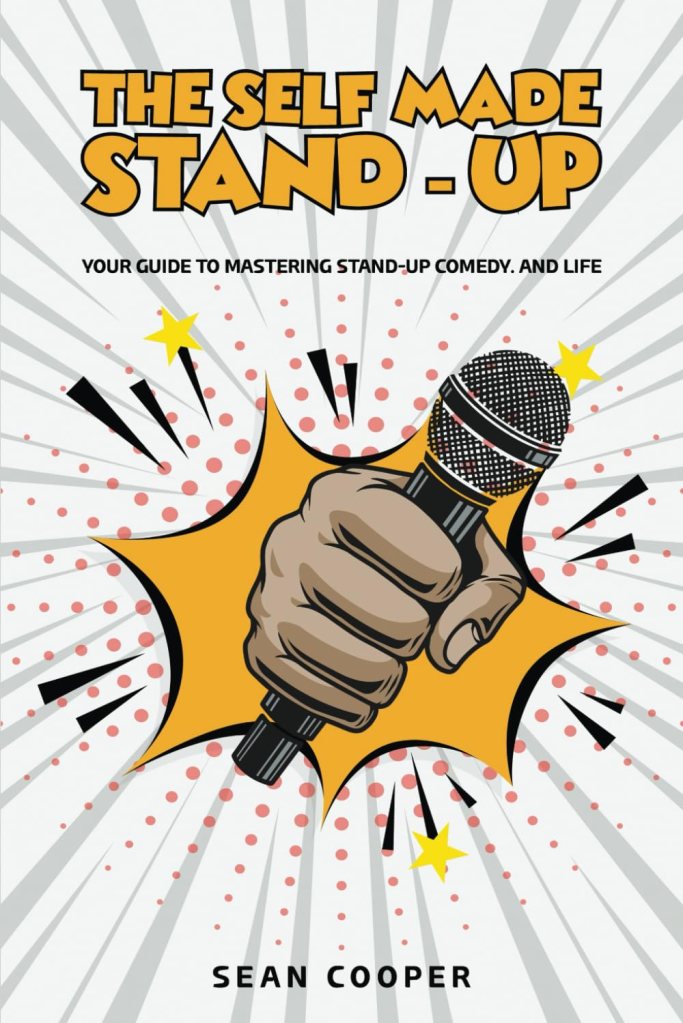
The Self Made Stand Up is available as a paperback or e-book from Amazon, Barnes and Noble, Books.By and lots of other places.
More than a how-to book, The Self-Made Stand-Up is an essential resource for developing yourself as an effective comedian. If you’re a comedian, or looking to become one, The Self-Made Stand-Up is the emotional support animal you need.
 Sean Cooper, Comedian
[…] mentioned last week that comedians need to think about their Premises, and to try and align those premises with their […]
LikeLike