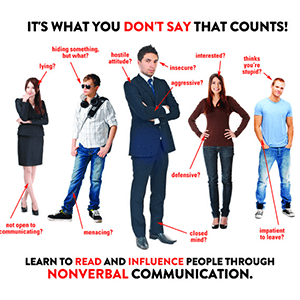
Back in the early eighties there were a few trends that the entire world seemed to be obsessed with, and seem to have a lasting fascination today. The Rubik’s Cube was one of these, and so was the book Body Language by Allan Pease. I’m not sure whether it was the first acknowledgement of communication that’s not verbal, but it sure felt like it.
At the time, we all went wild for it and thought we were learning some kind of magic mind-reading power. It was secret knowledge that only those of us who’d read the book were privy to. Now the idea that there’s a difference between people’s words and their thoughts, and that their unconscious cues are more revealing than their conscious ones, is widespreal. It’s so pervasive I’ve had several employers give me their crash course in it; nearly as often as I’ve had to be act impressed during the many, many times I’ve been introduced to MBTI personality tests in various workplaces.
These days we all accept the idea that you can communicate intent with your body language and posture. Lawyers train witnesses that open upturned hands signal honesty. Dating gurus teach that leaning forward and towards us means interest, that leaning or turning away indicates the opposite, and that hair-touching is a green light. Business experts know that crossed arms means resistance or defensiveness, and that dominance or power is communicated with a confident stance and a firm handshake in which you literally try to gain the upper hand.
This is basic and uncontroversial stuff. But what does it mean for comedians?
We’re in the business of selling ideas. Every little booster to drive those ideas home makes our jokes punchier and more effective, so it pays to be conscious of body language. It adds as much to delivery as our vocal intonation, cadence and rhythm. Once you see how effective a well-timed shrug or fist-shake can be, you’ll regard using only your lips to communicate as something of a handicap.
Something I reference in my book is the importance of consistency. I emphasize the idea so strongly that I made “Inconsistency is the enemy of comedy” number two in my patented Four Noble Truths of Stand Up. When we send mixed messages we undercut our jokes and set ourselves up for failure. There’s loads of ways this can happen, which I talk about elsewhere, but I think we can all agree that the most basic and critical trap we can fall into is to demonstrate body language that’s inconsistent with the ideas we’re trying to implant.
Looking apathetic when we say we’re angry, looking confident when we’re communicating nervousness, etc (and their opposites) can leave you wondering why nobody bought what you were selling, or why the response turn s out to be a lot less than you were expecting.
Thankfully there’s an easy fix to this. A basic working knowledge of body language is easy to acquire these days, and all you have to do is think about the ideas you’re communicating to work out what you need to do with your hands and body to drive those ideas home.
In addition to what you project during specific jokes, you’ll want to consider your general demeanor when you’re on stage. I hope you’ve thought about what kind of comic you want to be, how you wish to be thought of. Many comics want to project a comfortable and playful air. It’s a great tone to increase that all-important likeability factor. This is achieved with open and relaxed body language.
Some comedians adopt the opposite persona. Think of Lewis Black, who’s comedy is often angry or frustrated. This has been a successful strategy, and it got him the speaking part for the character Anger in the animated Pixar movie “Inside Out.” You don’t even have to watch his performances to see what kind of body language he uses to sell this: I googled Lewis Black and the result was many images of him pointing, clenching his fist, raising his hands to the air, etc. Do the search yourself and you’ll see exactly what I mean.
Whatever you adopt, you need to look confident and comfortable with the choices you’ve made. Some of this is for that all-important likeability that you need for people to go along on a ride with you, but it also projects quiet authority. Appearing confident and comfortable will massively reduce people’s inclination to fuck with you. It can reduce heckling by as much as 96.2% in an imaginary survey I invented for this article.
Another reason to adopt a confident stance is to actually be more confident. Professor Richard Wiseman in his book Rip It Up argues that we feel powerful when we adopt powerful body language, and not the other way around like we usually assume. I’ve known comedians swear by a process of “power posing” that Wikipedia describes as a “self-improvement technique or life hack in which people stand in a posture that they mentally associate with being powerful, in the hope of feeling more confident and behaving more assertively.”
Does it work? I don’t know. Science doesn’t really back it up, and I won’t do it myself because comedians pretending to be superheroes in the green room always looks fucking ridiculous to me. But if it helps you quell your nerves enough to do what you need to, go for it. I won’t articulate my judgement to your face.
Speaking of looking like a douchebag 😉 we don’t do ourselves any favours by sending nonverbal signals that reduce likeability. Here’s one that we all do. We don’t notice we’re doing it, and we don’t think about it all – but once you know it you’ll never unsee it again:
I’m talking about the practice of pausing and slightly lowering the microphone from our lips right after we drop our punchlines.
Don’t know what I mean? Don’t think you do it? Watch some comedy and see almost everyone do it when you know what to look for. Watch it and realize that this makes the comedian look like an arrogant fuckface.
This act is a really subtle version of a mic drop. It’s a quiet signal to an audience that you’ve served them something brilliant and you now expect them to thank you with applause and laughter.
Notice a comedian do the pause/lower the mic combo three times in a row and tell me if you still think they’re awesome. I’d wager you’re actually picking up “condescending smug dickhead” vibes instead.
That is… until you notice that you also do it, and realize that we all do it. I do it, even when I’m trying not to. It’s hard not to, especially when we’ve all been told to sell our punchlines by signaling them and reminded not to “tread on our own jokes” by not pausing to let people laugh at them. Getting the balance right, between what we’re encouraged to do and doing it to a point where we’re spraying arrogance with every joke, is difficult and I haven’t worked it out myself yet. I never said all of this body language stuff would be easy.
I’ve written before about doing comedy on Zoom and other online meeting platforms, and I agree with all the other comedians who say it’s harder and less rewarding. There are many reasons for this but one that never enters the conversation is that we only see talking heads. All of those communication elements that come from posture and gesture are missing. It doesn’t help us sell our message on an already challenging platform.
Do you need to employ more body language in your act? Probably. Here’s a good test:
Get a friend to take 20 photos during your next set. If the results look like one photo copies 19 times, you probably need to introduce some physical dynamism to your performance. The results will help your jokes, your shows, the development of your persona and your promotional images.
The Self Made Stand Up is available as a paperback or e-book from Amazon, Barnes and Noble, Books.By and lots of other places.
More than a how-to book, The Self-Made Stand-Up is an essential resource for developing yourself as an effective comedian. If you’re a comedian, or looking to become one, The Self-Made Stand-Up is the emotional support animal you need.
 Sean Cooper, Comedian