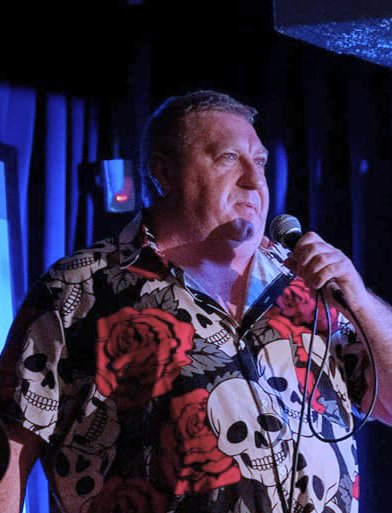
What does a comedian look like? Once upon a time it was the garb of a Court Jester, which according to a website named Jester Planet, consisted of “a motley coat, tight breeches and a cap’n’bells or monk’s cowl over their head, which was often shaved.” Apparently the outfit was symbolic. with the colours signalling opposition to the values of others within the court.
The comedian role had a uniform. Whether there’s still a dress code for comics, and that what dress code might entail depends entirely on who you ask. There’s quite a few schools of thought on the subject.
Does function dictate dress code? Not for most jobs, but nobody seems to think that’s the point.
For the last decade I’ve worked in Call Centers and almost all of them either had a uniform or imposed “corporate casual” dress code that was strongly enforced. Now, you might ask yourself why the hell a call center requires staff members who are never visible to comply with some arbitrary clothing regime that’s not even witnessed except by the people who are enforcing it?
And I’d say “You’re absolutely right. You must be absolutely anyone who’s not a crumby mid-level manager of some imperious self-important company who’s financial issues probably stem from it’s misplaced priorities!”
Fortunately, after Covid the work-from-home trend neutered this kind of bullshit pompous despotism. I suspect the current widespread demand for workers to return to the office is just so employers can resume imposing their otiose power-trips over their employees. But I digress…
A lot of comedians wear suits. For a long time comedians wore suits, and created an expectation that’s how a comic dresses for work. Jerry Seinfeld, John Mulaney, Steve Martin and Jimmy Carr would have us think so, citing a tradition that goes back to Don Rickles and Red Skelton. Even Lenny Bruce, who was repeatedly arrested and imprisoned for on-stage “indecency” wore a suit while performing.
There’s something very particular that these comics want to communicate. They want us to know they’re entertainers, they’re professionals, and they’re successful. Seinfeld’s spoken about how he’s always worn suits to gigs, that he viewed it as a minimum standard to communicate that he’s the one who speaks and not one of the audience, that it’s as much a signifier of being professional as turning up on time and work-ready.
The venue matters in these instances, too, because these are comedians who are more likely to be seen doing their thing in theaters and on television than in grungy comedy clubs or open mic at the pub in the seedy end of town.
Even when we appear in those places, we have to differentiate. The comedian who doesn’t draw some kind of line between audience and entertainer is more likely to find themselves challenged by hecklers and interlocutors at their shows. The comedian who doesn’t signal professionalism is less likely to get bookings, get respect and even get paid by some club owners. There’s pragmatic value in dressing like you’re here to work.
I have a mixed relationship with suits. I actually like them, think they look good and are comfortable, but I don’t get many opportunities to wear them in this part of the world.
If you’ve never spent a steamy summer in tropical North Queensland you can’t imagine how impractical it would be to wear one here. For nearly six months a year we’re stewing in our own sweat and breathing steam, and it wouldn’t occur to anyone that wearing a suit is anything but a ridiculous and impractical decision , drive by narcissism and complete lack of common sense.
Nearly thirty years ago I decided I didn’t want to wear a tie again, ever if possible. I had a nice tie collection at the time, and I’d believed that wearing a tie was some kind of signifier of status and authority. Now, I feel the opposite. Every job I’ve ever had to wear a tie for was a low-status entry level job and I’ve never been treated so poorly in the workplaces as when I was wearing a tie. I now the tie as a collar and leash, a sign of slavery.
I see a lot of people wearing ties, many of whom are aggressively slick and insincere, are completely delusional about their actual authority. Also, it hasn’t escaped my attention that this particular garment has no practical use. It doesn’t protect you from the elements. It’s a phallic symbol and I’m not doing it.
Anyway, there’s a widespread idea that entertainers should dress in a way that tells their audiences that they’re different from us. The thinking is that entertainers should act like rock stars, and signal their rockstar status by dressing in a way that visually differentiates themselves from their audiences.

It’s always interesting when this happens, when a comedian who preaches the virtues of being likable and having relatable material will suddenly start dressing like a flamboyant supervillain from another universe.
The example that immediately springs to mind is Eddie Murphy who performed his 1987 Raw special dressed in a jumpsuit made of bright red leather, shirtless and unzipped to his navel.
The most hilarious part of the show was the first 11 uncomfortable minutes where Murphy engaged in an egregious level of homophobia while looking exactly like the kind of person he was attacking.
Another school of thought are the “men in black” comedians. I was one of these for a long time, wearing just plain black clothes on stage. I had two reasons for this. The first is that this is how I usually dress. I don’t have too many wild colours or crazy patterns in my wardrobe at home, and I’m most comfortable wearing black or muted colours.
The main reason, though, is the same reason that other comics like Louis CK and Ricky Gervais would perform in plain black clothes. They’re not trying to make you look at them, but to listen. We’re speaking, and we hope you’re listening. Note: If Louis CK ever does ask you to look at him, you are allowed to say no 🙂
Some comedians might wear diamond heels, a gold cape and a feather boa. They can prowl the stage, leap around, somersault, and do other exaggerated actions. They’re performing. They want your attention. They want you to look at them. They want to promote the messenger.
And some comedians will wear the most neutral clothing possible. They sometimes stay rooted in place, or even sit. They’re speaking. They want you to think about their material. They want you to listen to them. They’re more interested in promoting their message.
Is a performer promoting their jokes or are they promoting themselves? you can often tell by how much emphasis they put on how they look instead of how they sound. The revealing top, the gaudy clown suit or the witty slogan on the t-shirt are distracting and create cognitive lags in processing the material that’s streaming, but comedians who are more interested in promoting themselves than sharing what they have to say are untroubled by this factor.
Luke Heggie doesn’t wear black, but he doesn’t dress gaudy. He doesn’t prance all over the stage. He’s usually rooted to one spot snd leaves the mic in the stand. That’s because his material is dense and packed with irony, which he delivers it at a breakneck speed. He’s not pausing for you to catch up, so he won’t put up distracting speed bumps to decode his jokes either.
Unfortunately, I discovered that when you wear black everyone assumes you’re doing it to look slimmer, that you heard black clothes create the impression of slimness and you’re vainly engaging in a futile attempt to trick everyone out of seeing how fat you are. This is the feedback I got when I dressed as I usually do. Back to the drawing board.
Comedy is mostly just talking, in an informal way and often in an informal environment. The clothes we wear shouldn’t have to be a political minefield, but it’s actually pretty complicated and sometimes carry negative consequences.
I’ve heard from comedians that they deliberately dress down, worried about alienating or even attracting physical violence from audiences in blue-collar areas that might not find them sufficiently “relatable.” Road-dog comics who tour frequently and perform in a wide range of venues generally don’t present themselves in fancy suits.
One of widespread issues is when female comics bear the brunt of being judged for either being “too hot” or “not hot enough,” because appearance certainly does influence how much respect audiences grant us. That particular tightrope walk is something most female comics tread.
Something Dave Chapelle pointed out, something that initially seemed absurd but is now impossible to not see, is that pretty much every black comedian ever in Hollywood has been asked to wear a dress.
There’s something about the sight of a black man in drag that the gatekeepers and powerful people in American media find hilarious and irresistible. This is definitely a thing, something that high-draw heavyweight entertainers like Kevin Hart have had to comply with. For some reason it’s very important that Hollywood emasculate black men on a national platform. I’m glad Chapelle drew attention to it.
Fortunately for me I’m excluded from a lot of the shit that women and people of colour have to endure, and my challenges are the general ones. You wouldn’t think we’d have to agonize about what to wear when we tell jokes but we do, and that’s not just because we’re narcissistic performers.
I’ve spoken about the value of consistency, how we become more effective and give our material it’s best chance when we stop sending mixed signals. I’ve also mentioned that decoding a joke while it’s being streamed live will be a lot more successful if you’re not trying to read the wacky slogan on my shirt, so I’ll try and not wear anything that’s going to split your attention.
But even taking this into account, what to wear? How much do I need to differentiate, and how can I do it while staying relatable? How do I promote my brand while staying authentic? How do I tell an audience I’m professional without alienating them? Is a comic a special person who dresses in a particular way, or is it any old slob who can tell a joke? How do I appropriately reflect an environment and still express my individuality?
Something I’ve repeated pretty consistently in my blog posts over the years is that a comic you see has made a lot of choices. You won’t these choices, which happen behind the scenes, but the comedian in front of you has given a lot of conscious consideration to what joke structures, performance style, identity, social values and even what clothes they wear,
Almost every show I’ve done in the last year has been in a wine or cocktail bar, and that’s influenced my decision. Smart casual is a pretty easy brief to fill, and I don’t worry about whether it effectively promotes my brand because I’m not treating my creative outlet like a business I’m trying to develop. I’ll be guided by comfort. And the colour black.
 Sean Cooper, Comedian